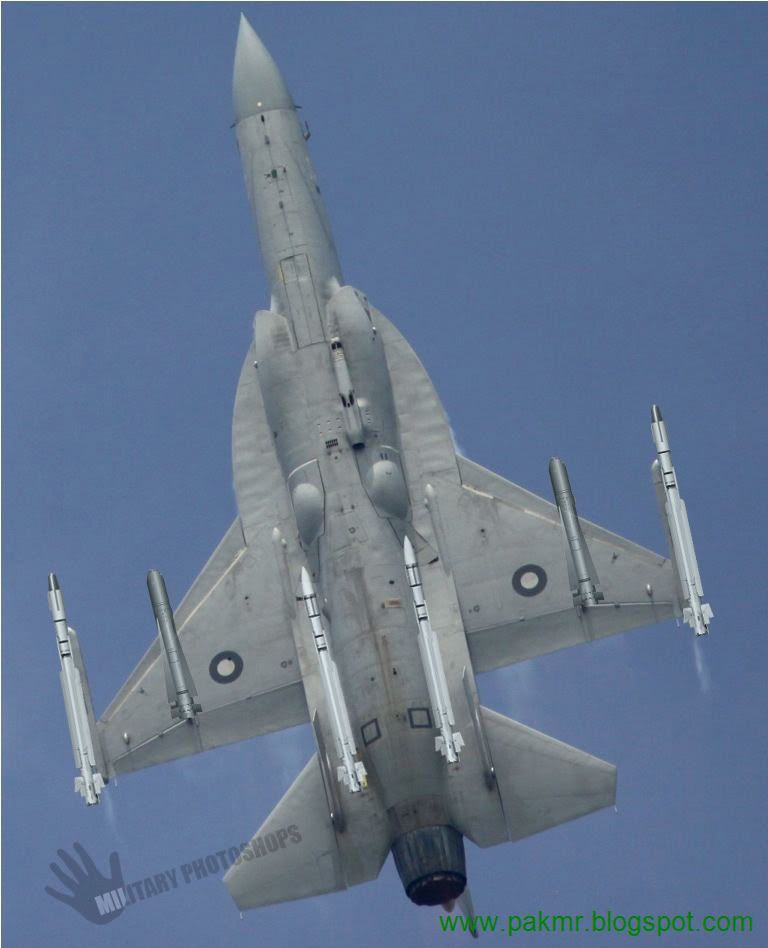
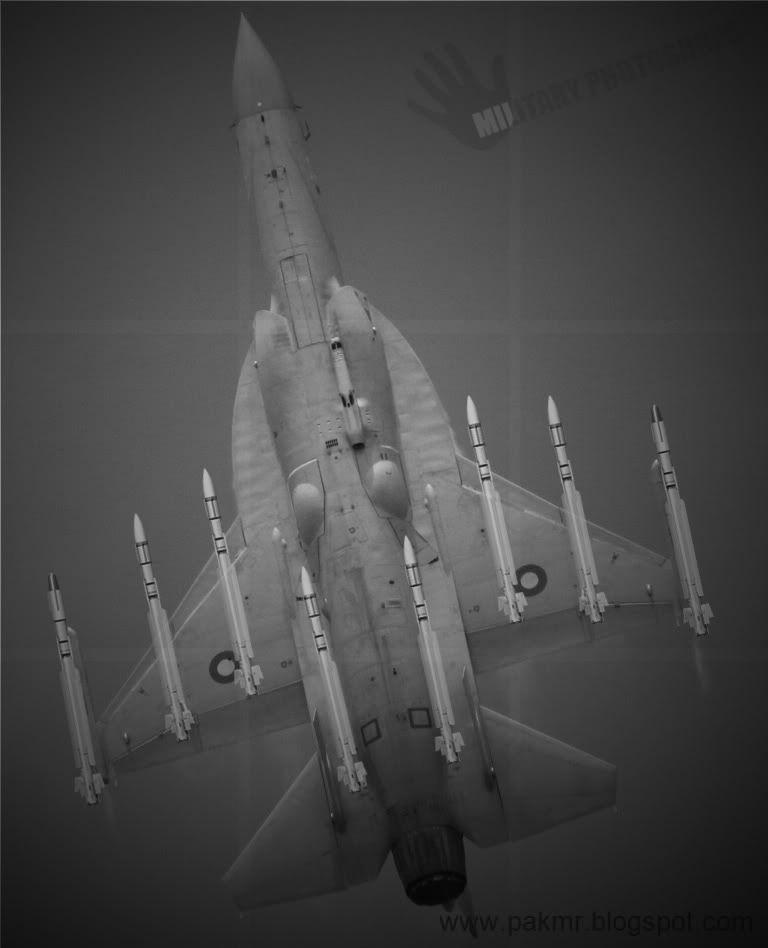
DISCLAIMER :

Dont believe anything you read, and half of what you see, here !


If a picture doesnt have the blog address as a watermark, it means it was not edited by me. Also we intentionally photoshoped these picture in a low quality photo manipulation, because we dont want anyone to repost this as the truth.

Most of the article are not ours either. We edited it to be match our posts or simply for seo.

Use your common sense to differentiate the truth from hoax.. we sometimes mix it all in.

Wednesday, December 28, 2011

Examining the Eurofighter Typhoon to Understand What Makes It Special

Fighter Jets And Men
Funny Photoshopped Pictures | Forward this Picture The Eurofighter is a highly maneuverable multirole Military fighter presently being developed by a 4 nation consortium consisting of Nice Britain, Germany, Italy, and Spain. In the late Nineteen Seventies, quite a lot of European air forces had been confronted with the fact that their fighter fleets had been beginning to appear outdated in the face of new American machines, such because the F-15 and F-sixteen, and more to the purpose new Soviet fighter designs, such as the MiG-29 and Su-27. These scorching new machines would certainly be adopted by improved designs, and so the Europeans needed to keep pace. In March 2006, the Eurofighter lastly entered service in the RAF, with the first operational Hurricane squadron fashioned on March 31st. In the present day the RAF's new Eurofighter Typhoon has the excellence of being probably the most controversial European fight aircraft since the stillborn TSR.2. Lauded by its proponents and trashed by its opponents, the aircraft seems to have a unprecedented means to generate public argument. In evaluating the Eurofighter Typhoon towards the only different fighter in its weight class, the F/A-18A/C, the benefits of using later generation know-how show very clearly. The Typhoon outperforms the F/A-18A/C in BVR weapon system functionality in addition to aerodynamic performance. While this Military Aircraft is significantly better than the F/A-18A/C in operating radius and agility, its optimum operating radius will not be in the class of the F-15 and Su-27/30. The notion that the aircraft is “virtually nearly as good as an F-22” shouldn't be supportable, indeed upgrading the F-15 with engines and a radar/IRS&T/AAM package of the identical generation as that of the Eurofighter Typhoonwould equalise almost all benefits held by the Typhoon over older F-15C/E variants. By the identical token, no upgrades performed on the F/A-18A/C would equalise the efficiency advantages of the Hurricane over these aircraft. The energy of the Hurricane is its very modern and comprehensive avionic bundle, particularly that in the RAF variant, and its excellent agility when operated round its optimum fight radius of about 300 NMI (a determine to be present in older Eurofighter literature, which has since disappeared with the export drive to compete against the larger F-15 and F-22). The Hurricane's weaknesses are its F/A-18C class weight and thrust and the implications of this in combat at extended operational radii, and the long term sensitivity of its BVR weapons benefit to equal technological developments in opposing fighters. In terms of where to position the Storm within the present menagerie of fighter plane, it can be best described as an F/A-18C sized fighter with BVR programs and agility efficiency better than older F-15 fashions, much like development F-15 fashions with identical era techniques and engines, however inferior to the F-15 in useful working radius. The Storm isn't a stealth aircraft, regardless of varied assertions to this effect, nor is it a real supercruiser like the F-22. Its design incorporates not one of the features seen in very low observable varieties, nor does the EJ200 incorporate the unique design options of the F119 and F120 powerplants. The Hurricane is actually not a lemon, although the knowledge of mass producing a excessive efficiency conventional fighter of its ilk in a period where stealth is about to hit mass production within the F-22 and JSF packages might be seriously questioned. It represents what is more likely to be the final main evolutionary step in the teen sequence design philosophy. For additional information, about this and other topics make sure you continue to explore internet resources around the web such as Military Family Preparedness . There are infinite assets available on this and similar content.

Wednesday, November 9, 2011

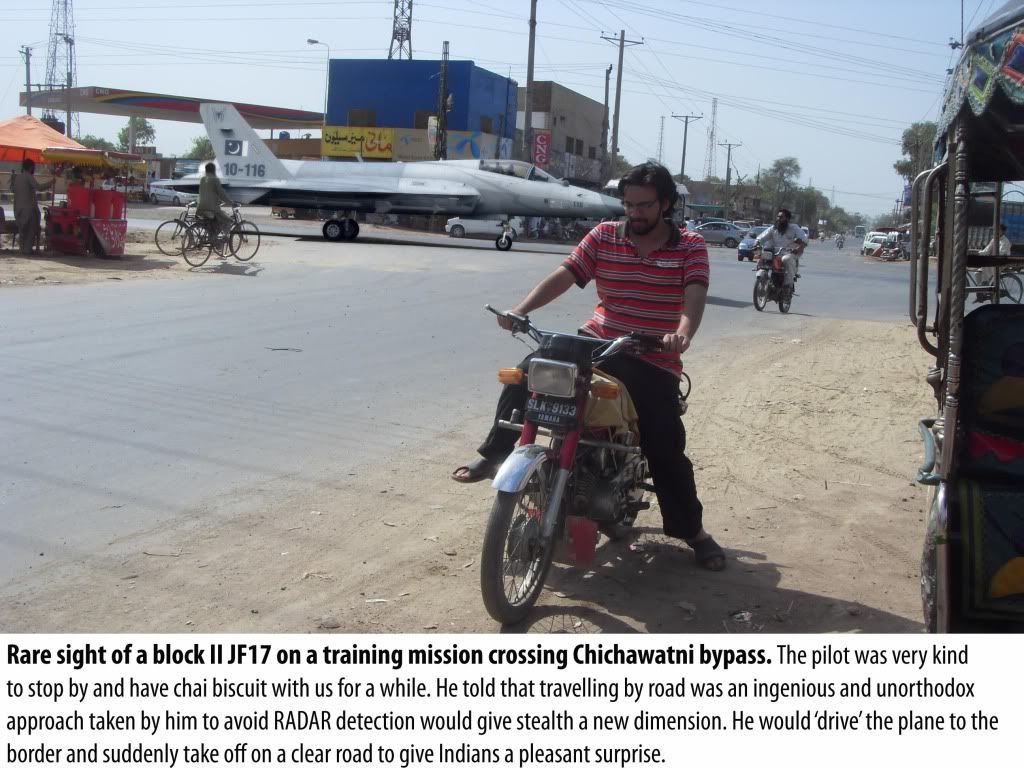
' Jf-17 on Chichawatni Bypass ' gets featured .


Well, well, this one pic seems to making quite a buzz at social networking sites.
It came to my notice quite unexpectedly. Actually, i took this pic almost a year before and the guy on the bike in front is my younger brother. Someone shared it on Media Mug International s Facebook page, Here , with 674 likes, 357 shares and 174 comments. Though most of them are just plain stupid.

Anyways, then it got shared on various other pages and finally made it to an Islamabad University Alumni page, of which my bro is a member. His friends recognized him and called to ask if he was really him. haahahaha. Now i guess i understand how ppl feel when they become a celeb overnight. well, almost..... u dont have to eat a bucket load of salt to know what it tastes like or do you ?

Now someone's shared it on Reddit too , Here

Thursday, May 12, 2011

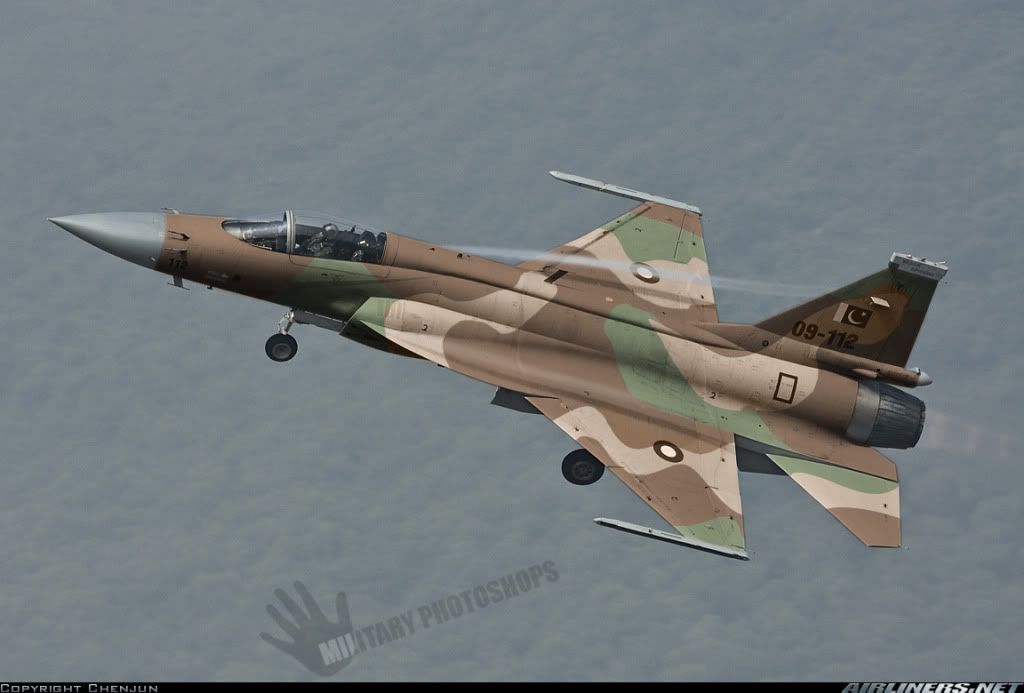
Jf-17 Thunder in Desert Camoflague

ISLAMABAD: A Pakistan Air Force spokesperson said on Monday that JF – 17 Thunder Jet fighters have been inducted into the PAF’s 26th Squadron.

Pakistan’s JF-17 Thunder Jet fighters have been designed in collaboration with China but have been manufactured indigenously.

The spokesperson said that the induction took place during a special ceremony at a PAF operational base.

Pakistan Air Force chief Rao Qamar Suleman made an address during the ceremony and thanked the Chinese government for its cooperation in preparing the jets.

He said Pakistan is in a state of war and the air force will do everything in its power to defend the nation.

He added the 26th Squadron previously had A5 Jet fighters only and that the JF-17 Jets will also be soon inducted in the 16th Squadron as well.


My earlier posts Featuring JF17 in Desert camo can be seen HERE and HERE.

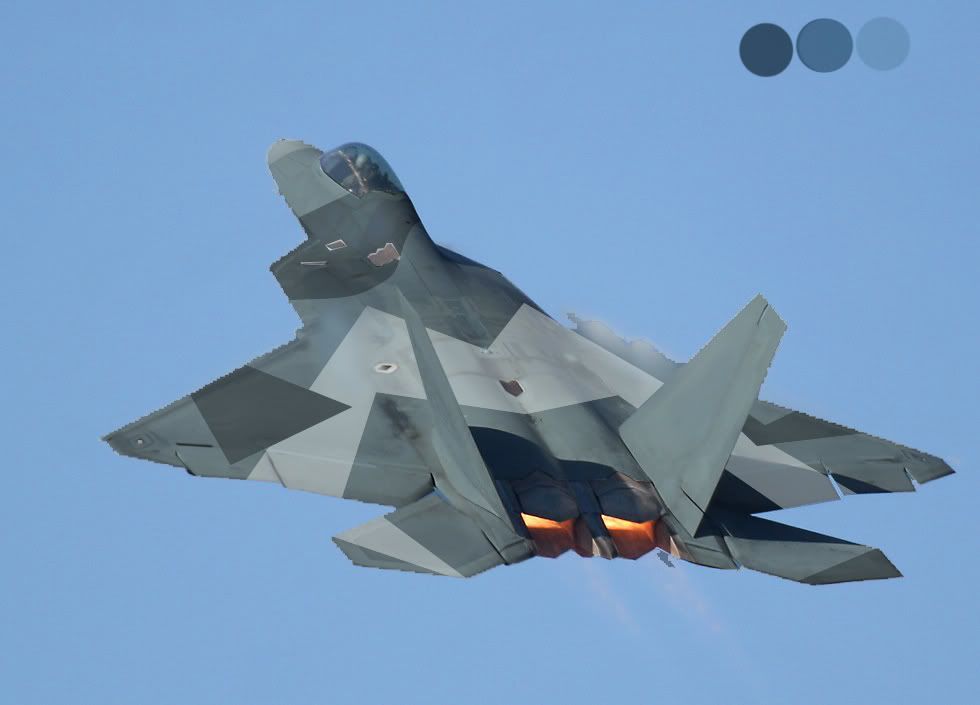
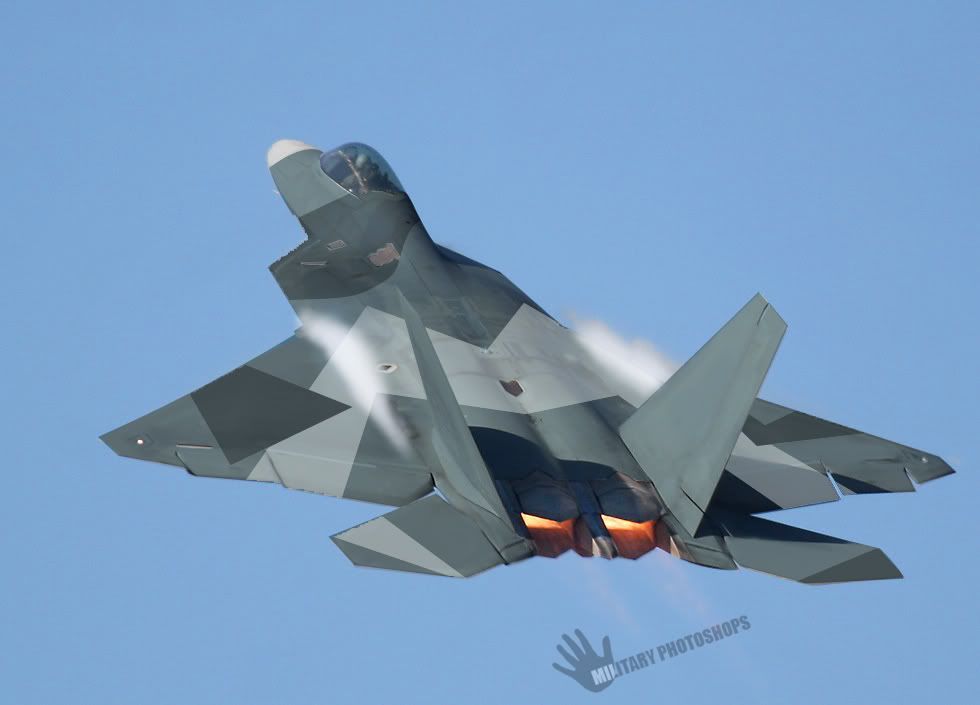
F/A-22 Raptor in Russian T-50/PAKFA Camoflague

The Lockheed Martin/Boeing F-22 Raptor is a single-seat, twin-engine fifth-generation supermaneuverable fighter aircraft that uses stealth technology. It was designed primarily as an air superiority fighter, but has additional capabilities that include ground attack, electronic warfare, and signals intelligence roles. Lockheed Martin Aeronautics is the prime contractor and is responsible for the majority of the airframe, weapon systems and final assembly of the F-22. Program partner Boeing Defense, Space & Security provides the wings, aft fuselage, avionics integration, and all of the pilot and maintenance training systems.

The aircraft was variously designated F-22 and F/A-22 during the years prior to formally entering USAF service in December 2005 as the F-22A. Despite a protracted and costly development period, the United States Air Force considers the F-22 a critical component for the future of US tactical air power, and claims that the aircraft is unmatched by any known or projected fighter, while Lockheed Martin claims that the Raptor's combination of stealth, speed, agility, precision and situational awareness, combined with air-to-air and air-to-ground combat capabilities, makes it the best overall fighter in the world today. Air Chief Marshal Angus Houston, Chief of the Australian Defence Force, said in 2004 that the "F-22 will be the most outstanding fighter plane ever built."

The high cost of the aircraft, a lack of clear air-to-air combat missions because of delays in the Russian and Chinese fifth generation fighter programs, a US ban on Raptor exports, and the ongoing development of the supposedly cheaper and more versatile F-35 resulted in calls to end F-22 production. In April 2009 the US Department of Defense proposed to cease placing new orders, subject to Congressional approval, for a final procurement tally of 187 Raptors. Then the National Defense Authorization Act for Fiscal Year 2010 was signed into law in October 2009 without funding for further F-22 production.


The Sukhoi PAK FA (Russian: Перспективный авиационный комплекс фронтовой авиации, Perspektivny aviatsionny kompleks frontovoy aviatsii, literally "Prospective Airborne Complex – Frontline Aviation") is a twin-engine jet fighter being developed by Sukhoi OKB for the Russian Air Force.

The current prototype is Sukhoi's T-50.[12] The PAK FA, when fully developed, is intended to be the successor to the MiG-29 and Su-27 in the Russian inventory and serve as the basis of the Sukhoi/HAL FGFA being developed with India.[13][14] A fifth generation jet fighter, the T-50 performed its first flight 29 January 2010.[3][15] Its second flight was on 6 February and its third on 12 February 2010. As of 31 August 2010, it had made 17 flights and by mid-November, 40 in total. The second prototype was to start its flight test by the end of 2010, but this was delayed until March 2011.[16][17][18][19][20]

Sukhoi director Mikhail Pogosyan has projected a market for 1,000 aircraft over the next four decades, which will be produced in a joint venture with India, two hundred each for Russia and India and six hundred for other countries.[21] He has also said that the Indian contribution would be in the form of joint work under the current agreement rather than as a joint venture. The Indian Air Force will "acquire 50 single-seater fighters of the Russian version" before the two seat FGFA is developed. The Russian Defense Ministry will purchase the first 10 aircraft after 2012 and then 60 after 2016. The first batch of fighters will be delivered without the "Fifth generation" engines.[26] Ruslan Pukhov, director of the Centre for Analysis of Strategies and Technologies, has projected that Vietnam will be the second export customer for the fighter. The PAK-FA is expected to have a service life of about 30–35 years.

Saturday, May 7, 2011

Jf-!7 Block 2 Upgrade with French MICA

In the long wish list of JF17 upgrades, there are many things i want to see. One of them is adding the number of Pylons for Jf17 Thunder to carry additional missiles .
In its present standard CAP configuration, JFT will carry 2x PL-9 AAM, 2x SD-10 BVRAAM, and 3x drop tanks and this seems a little less compared to modern generation aircraft . Although Dual Launcher for SD-10 will address this problem. I think going for an additional Pylon like the French have gone for on Dassault Rafale and earlier on Mirage 2000, is the most logical next step to add more punch to JFT. As having this additional pylon enhances Multirole capabilities of JF17. Now JFT can carry 4x AAM, 3x Drop tanks, 2x AGMs.

Below is the rendition :


and some words about MICA (missile) :

From Wikipedia, the free encyclopedia

The MBDA MICA (Missile d’interception et de combat aérien, “Interception and Aerial Combat Missile”) is an anti-air multi-target, all weather, fire-and-forget short and medium-range missile system. It is intended for use both by air platforms as individual missiles as well as ground units and ships, which can be equipped with the rapid fire MICA Vertical Launch System. It is fitted with a thrust vector control (TVC) system.

It was developed from 1982 onward by Matra. The first trials occurred in 1991, and the missile was commissioned in 1996 to equip the Rafale and Mirage 2000. It is a replacement for both Super 530 (interception) and Magic II (dogfight). Two can be fired in a two-second interval.
Contents


There are two MICA variants; MICA RF has an active radar homing seeker and MICA IR has an imaging infra-red homing seeker. Both seekers are designed to filter out counter-measures such as chaff and decoy flares. A thrust vector control unit fitted to the rocket motor increases the missile's agility. It is capable of lock-on after launch (LOAL) which means it is capable of engaging targets outside its seeker's acquisition range.

MICA can also be employed as a short-range surface-to-air missile as the VL MICA SHORAD; in this form it is fired from a truck-mounted box launcher. On October 23, 2008, 15:30, at CELM, Biscarosse (Landes), a VL MICA missile successfully performed the last of its 14 test firings meaning it is now ready for mass production. The RPV was flying at low level, on the sea, 12 km away; despite this distance (roughly twice the range of Sea Wolf), MICA (with an active radar seeker) locked on the target and shot it down. Corvettes too small to have the costly Aster missile systems will be the best customer for this weapon, that basically is an Aster without its booster and PIF-PAF vectorial control(as example, the diameter and radar are roughly the same in both Mica and Aster).[2]

The Armée de l'Air received its first MICA batch in the 1990s with its 37 Mirage 2000-5. The French Air Force and Navy have ordered a total of 1110 MICAs, divided equally between RF and IR versions; 1000 missiles had been delivered by November 2010. MICA is also offered for export, the first sale was made to Taiwan in 1992 when the Republic of China Air Force (ROCAF) ordered some 960 missiles in both RF and IR versions to arm its new Dassault Mirage 2000 fighter aircraft.[3]

LinkWithin

Related Posts Plugin for WordPress, Blogger...