Showing posts with label USNAF. Show all posts
Showing posts with label USNAF. Show all posts
Saturday, January 7, 2012


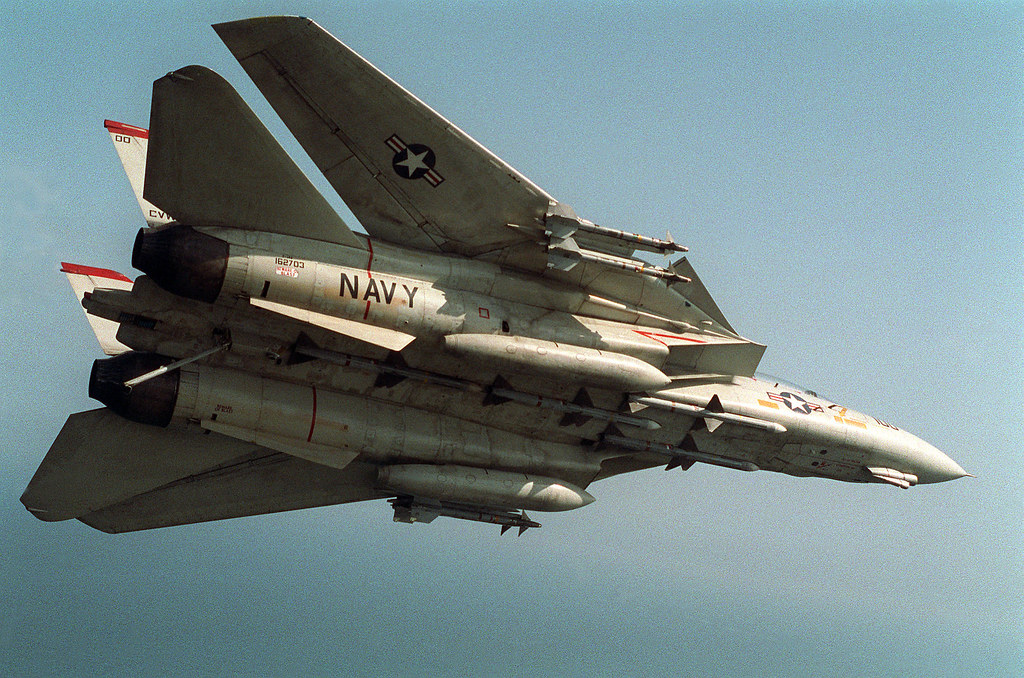


F-14 fighter jet wallpapers

 Lieutenant West McCall F-14 pilot from Deland, Fla., and Lieutenant
Kimberly Arrington, a Radar Intercept Officer from King, N.C., test fire
a Phoenix air to air missile as part of an Annual Proficiency exercise.
Lieutenant West McCall F-14 pilot from Deland, Fla., and Lieutenant
Kimberly Arrington, a Radar Intercept Officer from King, N.C., test fire
a Phoenix air to air missile as part of an Annual Proficiency exercise. Pula, Croatia (Oct. 28, 2002) -- An F-14B "Tomcat" Fighter jet flies in
formation with a pair of MiG-21 assigned to the Croat Air Force.
Pula, Croatia (Oct. 28, 2002) -- An F-14B "Tomcat" Fighter jet flies in
formation with a pair of MiG-21 assigned to the Croat Air Force.
2) Northern Iraq (Apr. 11, 2003) -- A U.S. Navy Grumman F-14 Tomcat assigned to Carrier Air Wing Three onboard USS Harry S. Truman (CVN 75), flies a combat mission in direct support of Operation Iraqi Freedom.

A F-14 Fighter aircraft (VF-143) "Pukin Dogs" receives final maintenance before evening flight operations on the flight deck of USS GEORGE WASHINGTON (CVN73).
 An F14B Tomcat assigned to Fighter Attack Squadron Three Two (VF-32)
(Swordsmen) Prepares to land on the flight deck of Truman . USS Harry S.
Truman (CVN 75)
An F14B Tomcat assigned to Fighter Attack Squadron Three Two (VF-32)
(Swordsmen) Prepares to land on the flight deck of Truman . USS Harry S.
Truman (CVN 75)
An F14D Tomcat assigned to the "Blacklions" of Fighter Squadron Two One Three (VF-213) launches from USS Theodore Roosevelt (CVN 71).

An F14D Tomcat from Fighter Squadron Three One (VF-31), the “Tomcatters,” performs a fly by past the Nimitz-class aircraft carrier USS Dwight D. Eisenhower (CVN 69). The Grumman F-14 Tomcat is a supersonic, twin-engine, variable sweep wing, two-place strike fighter. The Tomcat's primary missions are air superiority, fleet air defense and precision strike against ground targets.(4) U.S. Navy photo by Paul Farley

An F14D Tomcat assigned to the "Tomcatters" of Fighter Squadron Three One (VF-31) launches from the flight deck of aircraft carrier

 Arabian GulfAboard USS Theodore Roosevelt (CVN 71)Sailors part of
Fighter Squadron Three One (VF-31) prepares to do maintenance on an F-14
Tomcat on the flight deck of USS Theodore Roosevelt (CVN 71). The
nuclear powered aircraft carrier and embarked Carrier Air Wing Eight are
currently underway on a regularly scheduled deployment conducting
maritime security operations.
Arabian GulfAboard USS Theodore Roosevelt (CVN 71)Sailors part of
Fighter Squadron Three One (VF-31) prepares to do maintenance on an F-14
Tomcat on the flight deck of USS Theodore Roosevelt (CVN 71). The
nuclear powered aircraft carrier and embarked Carrier Air Wing Eight are
currently underway on a regularly scheduled deployment conducting
maritime security operations.
Arabian
Gulf (July 09, 2004) - An F-14D Tomcat fighter jet assigned to the
Jolly Rogers of Fighter Squadron (VF 103) and an F/A-18C Hornet assigned
to the Sunliners of Strike Fighter Squadron Eight One (VFA 81) makes
final preparation for launch from the flight deck of USS John F. Kennedy
(CV 67). USS John F. Kennedy Strike Group currently on a regularly
scheduled deployment, is taking part in Summer Pulse 04.

OVER
IRAQ -- An F-14 Tomcat flies through the sky during a combat mission
August 14 in support of Operation Iraqi Freedom. (U.S. Air Force photo
by Staff Sgt. Lee O. Tucker 

Thursday, January 5, 2012
USN F-14 Tomcat Fact file and photos
 |
| USN F-14 |
 |
| F-14 goes super sonic |
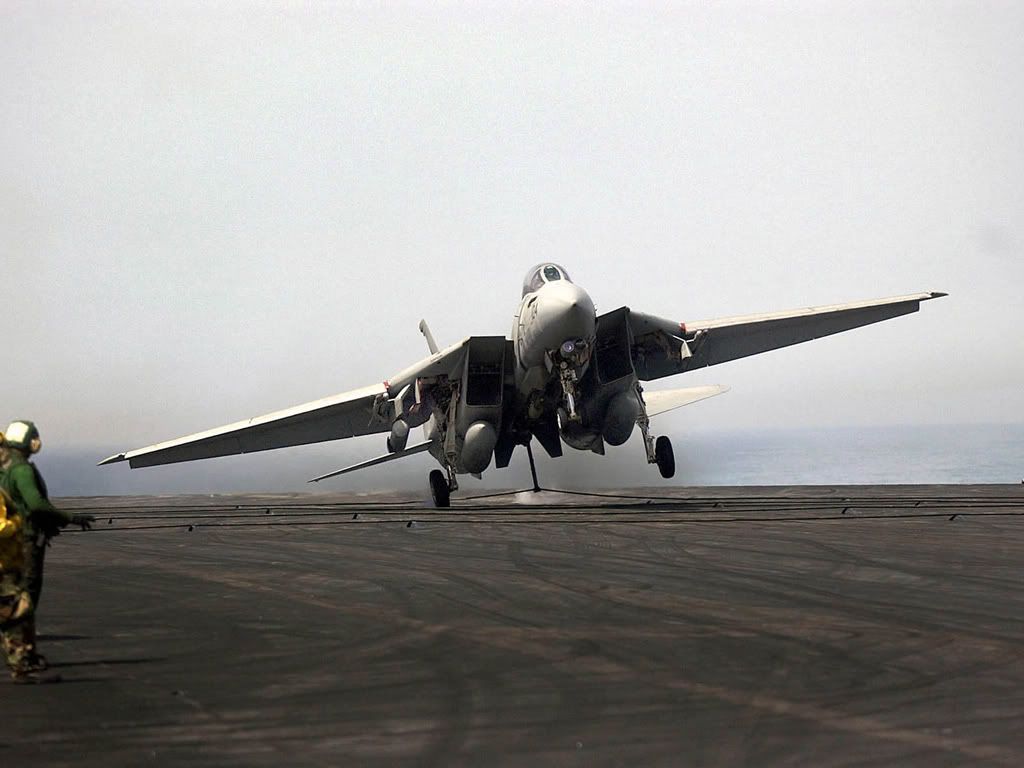 |
| F-14 dangerous carrier landing |
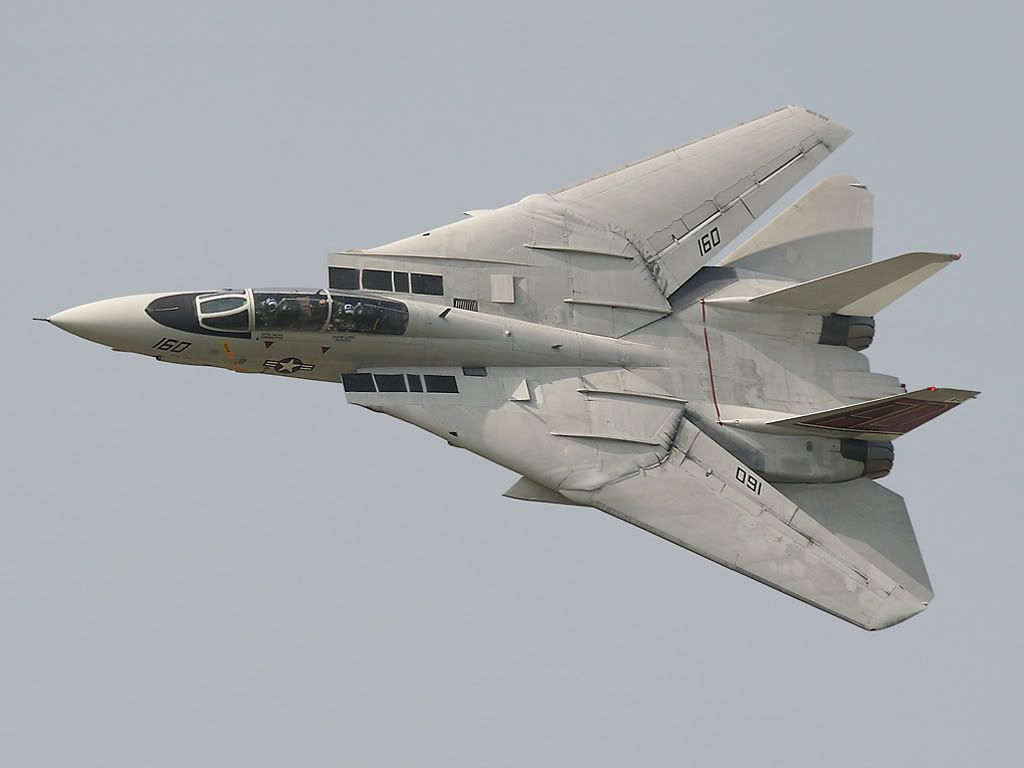 |
| F-14 swing wing fighter, with folded back wings for high speed pass |
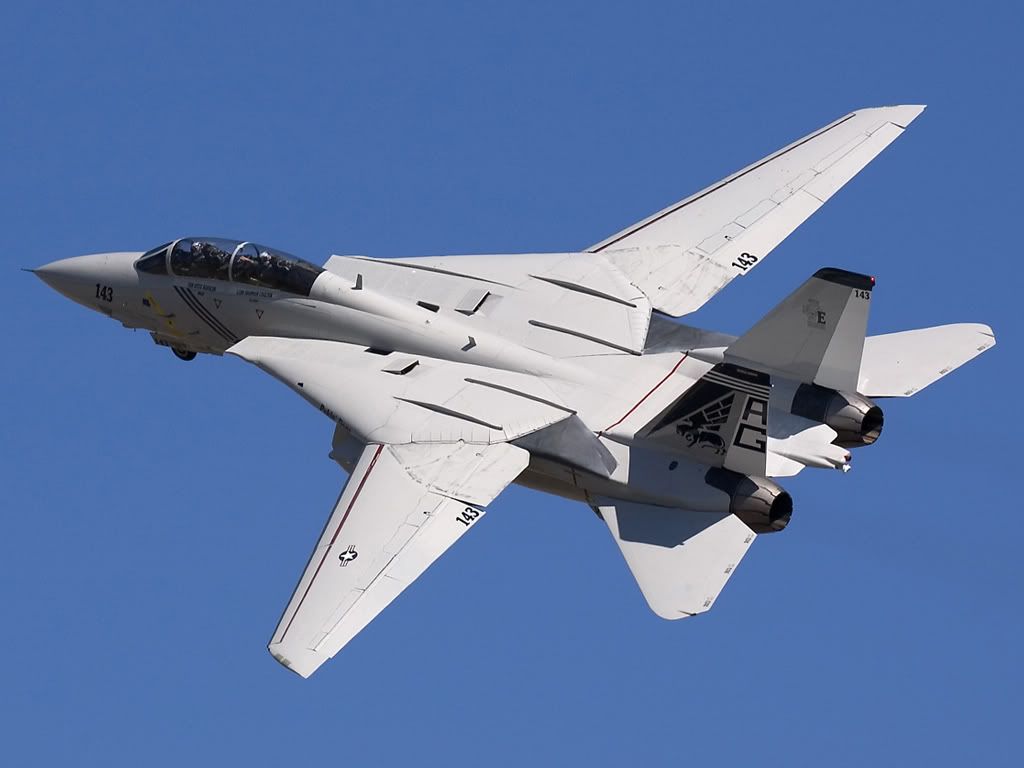 |
| F-14 with spread wings for take off |
Saturday, December 31, 2011
Pak-Fa Impact on future USAF

In the Cold War, you could rely on the Pentagon and the USAF to play up the Soviet threat for all it was worth. The MiG-25? Not only Mach 3 but an agile dogfighter. The Tu-22M Backfire was a B-1 equivalent with the range for strategic attacks against the US. And if you disagreed with the USAF that the nation consequently needed lots of F-15s and B-1s, you were clearly some kind of fluoride-swilling crypto-Commie prevert.
There was actually a running fight between the military intelligence agencies and the CIA, which bypassed the Pentagon and took its data to black-program teams within industry. The most public rumpus was over Backfire, where the boss of USAF intelligence tried to force McDonnell Douglas to recant the conclusions of a CIA-contracted team within the company, whose estimates of the bomber's performance were lower and far more accurate than those of Air Force analysts and the Defense Intelligence Agency.
So it's ironic to see USAF leaders downplaying the potential of the T-50,as in this report from Air Force Times. “I didn’t see anything … that would cause me to rethink plans for the F-22 or F-35,” Air Force Secretary Michael Donley was quoted as saying. Pacific Air Forces commander Gen. Gary North, added: “I guess the greatest flattery is how much they copy you.”
Donley's comment, of course, is a demonstration of the Mandy Rice-Davies principle in action: He would say that, wouldn't he? His immediate predecessor was canned for (among other things) expressing incorrect and counter-revolutionary sentiments regarding his boss's F-22/F-35 plan.
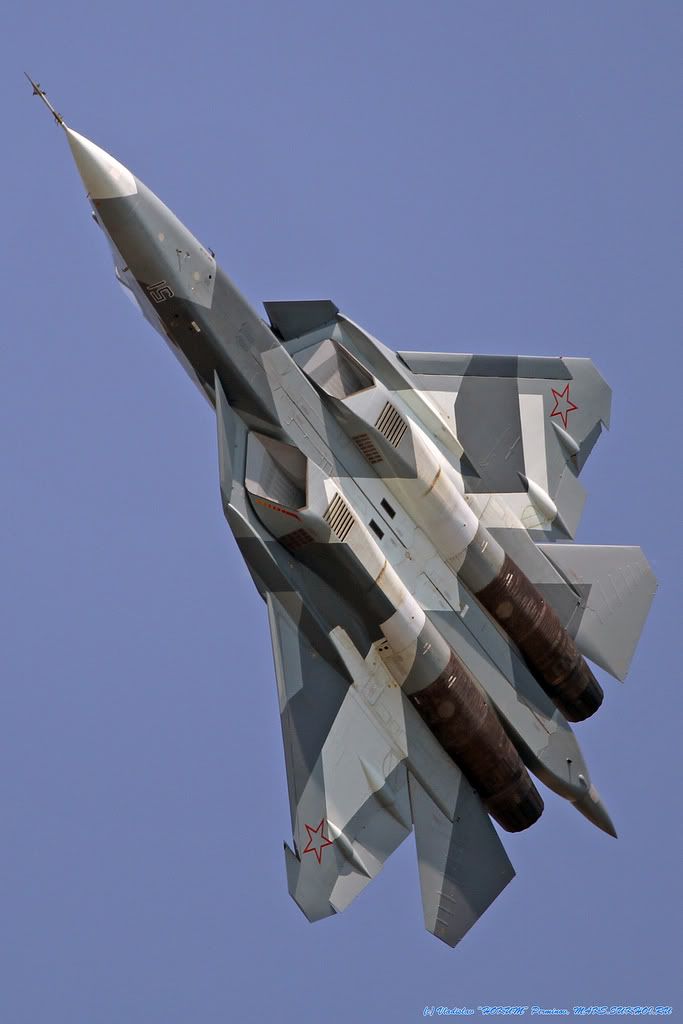
Gen. North, meanwhile, is falling into the old technical intelligence trap called mirror-imaging: we want the B-1, so the Soviets must want a B-1 as well. The PAK-FA's front end bears a superficial resemblance to the F-22, but its hindquarters could not be more different, and - just for starters - it's a reasonable assessment that the Russian concept of balancing stealth with other requirements is very different from that which informed the F-22 design.
I'm not sure that anyone has an accurate assessment of the PAK-FA threat, in terms of timing, numbers and detailed capability - that will depend on how fast the Russia-India relationship can move things forward, which in turn depends on money, as well as on technical resources. But it is pretty clearly a supercruiser, probably a good one, with some unique features that are there to combine speed and high agility without counter-stealthy aerodynamic surfaces all over the place.
And had you started thinking about this kind of design in the late 1990s, and if "eating F-35s for breakfast" was on the requirements list, you'd end up with something like T-50. So I'd suggest that writing it off as a me-too F-22 is a bit premature.
By Bill Sweetman
Saturday, May 7, 2011
US Navy Aggressor J-10 S
An aggressor squadron is a squadron that is trained to act as an opposing force in military wargames. Aggressor squadrons use enemy tactics, techniques, and procedures to give a realistic simulation of air combat (as opposed to training against one's own forces). Since it is impractical to use actual enemy aircraft and equipment, surrogate aircraft are used to emulate potential adversaries. The US Navy and Marine Corps use the term "Adversary" to describe their similar squadrons. The first formal use of dissimilar aircraft for training was in 1968 by the Navy Fighter Weapons School (better known as "TOPGUN"), which used the A-4 Skyhawk to simulate the performance of the MiG-17. The success of formalized Dissimilar air combat training (DACT) led to transition of Navy Instrument Training Squadrons equipped with the A-4 into Adversary Squadrons at each master[clarification needed] jet base. The USAF followed suit with their first Aggressor squadrons at Nellis AFB equipped with the readily available T-38 Talon.

US Squadrons
Some US aggressor camouflage schemes emulate Russian markings, such as the multiple shades of blue and gray on this US Navy F/A-18.
Aggressor squadrons in the US armed forces include the USAF 18th Aggressor Squadron at Eielson AFB, the 64th and 65th Aggressor Squadrons at Nellis AFB, the US Marine Corps' VMFT-401 at MCAS Yuma and the US Navy's VFC-12 at NAS Oceana, VFC-13 at NAS Fallon and VFC-111 at NAS Key West, as well as the famous "TOPGUN" Naval Fighter Weapons School (US Navy) which is not a squadron per se, but operates F-16A and F/A-18A/B/E/F aircraft as part of the Naval Strike and Air Warfare Center (NSAWC) at NAS Fallon. With the exception of the NSAWC aircraft, all the US Navy and US Marine Corps adversary squadrons are Reserve Component units and aircraft belonging to the Navy Reserve and the Marine Corps Reserve.
The USAF also operated Aggressor squadrons in the UK and in the Philippines. The 527 AS was a USAFE unit that first operated out of the former RAF Alconbury near Cambridge, England, then later from the former RAF Bentwaters near Ipswich. The 527th initially flew F-5s, then later switched to F-16s; and trained over the North Sea and in Germany, Spain and Italy. The PACAF counterpart, the 26th Training Aggressor Squadron, operated F-5s out of the former Clark Air Base near Angeles City, Philippines.
Yeah i copied it from Wikipedia. i ve removed the markings from this J-10 and painted it in USN Aggressor Camoflague .

US Squadrons
Some US aggressor camouflage schemes emulate Russian markings, such as the multiple shades of blue and gray on this US Navy F/A-18.
Aggressor squadrons in the US armed forces include the USAF 18th Aggressor Squadron at Eielson AFB, the 64th and 65th Aggressor Squadrons at Nellis AFB, the US Marine Corps' VMFT-401 at MCAS Yuma and the US Navy's VFC-12 at NAS Oceana, VFC-13 at NAS Fallon and VFC-111 at NAS Key West, as well as the famous "TOPGUN" Naval Fighter Weapons School (US Navy) which is not a squadron per se, but operates F-16A and F/A-18A/B/E/F aircraft as part of the Naval Strike and Air Warfare Center (NSAWC) at NAS Fallon. With the exception of the NSAWC aircraft, all the US Navy and US Marine Corps adversary squadrons are Reserve Component units and aircraft belonging to the Navy Reserve and the Marine Corps Reserve.
The USAF also operated Aggressor squadrons in the UK and in the Philippines. The 527 AS was a USAFE unit that first operated out of the former RAF Alconbury near Cambridge, England, then later from the former RAF Bentwaters near Ipswich. The 527th initially flew F-5s, then later switched to F-16s; and trained over the North Sea and in Germany, Spain and Italy. The PACAF counterpart, the 26th Training Aggressor Squadron, operated F-5s out of the former Clark Air Base near Angeles City, Philippines.
Yeah i copied it from Wikipedia. i ve removed the markings from this J-10 and painted it in USN Aggressor Camoflague .
Subscribe to:
Posts (Atom)
LinkWithin
