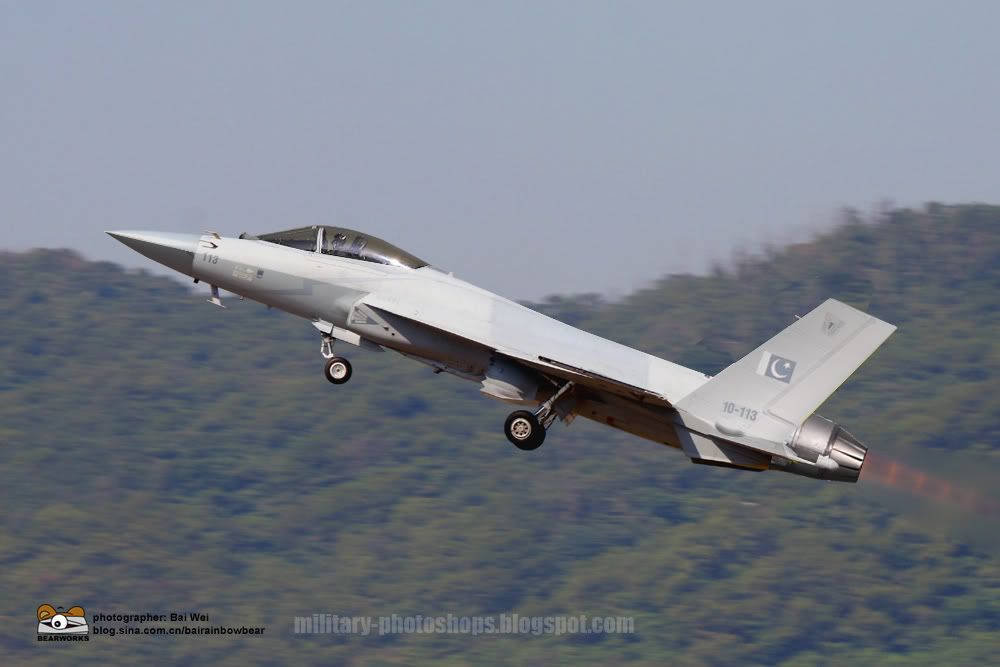
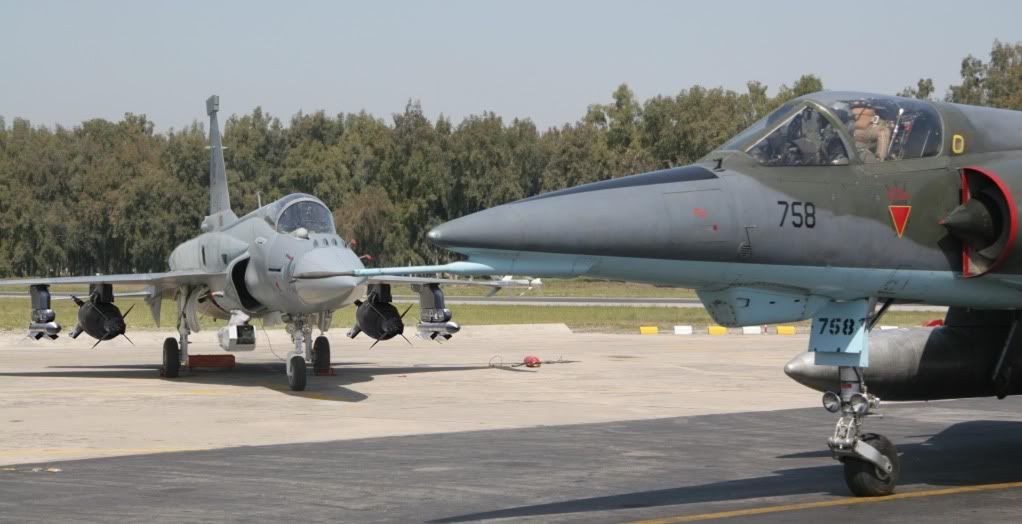
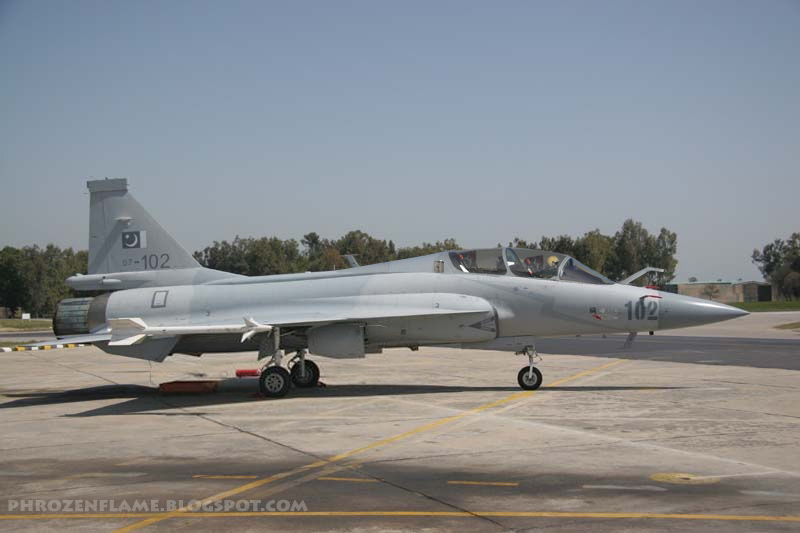
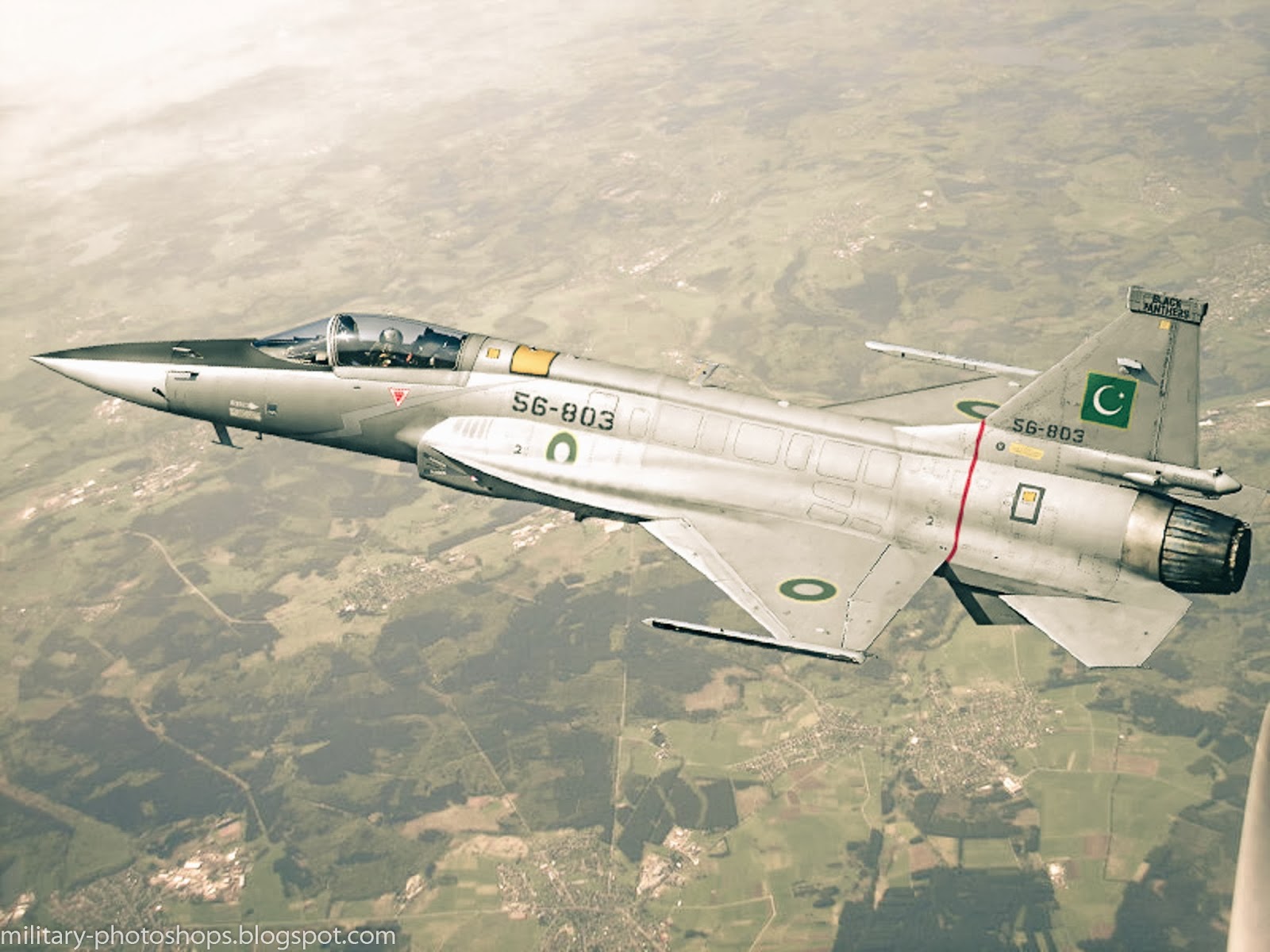
This design incorporates the idea of affordable stealth as the small size of jf17 does not allow the placement of an internal weapons bay. Though the decrease in range can be accounted for by IFR . So this prototype of jf17 has to carry weapons on the external pylons. A Jf17 carrying A2A payload will have relatively small profile as compared to A2G payload, and will pose a major threat to enemy forces.
DISCLAIMER :
Dont believe anything you read, and half of what you see, here !
If a picture doesnt have the blog address as a watermark, it means it was not edited by me. Also we intentionally photoshoped these picture in a low quality photo manipulation, because we dont want anyone to repost this as the truth.
Most of the article are not ours either. We edited it to be match our posts or simply for seo.
Use your common sense to differentiate the truth from hoax.. we sometimes mix it all in.
Dont believe anything you read, and half of what you see, here !
If a picture doesnt have the blog address as a watermark, it means it was not edited by me. Also we intentionally photoshoped these picture in a low quality photo manipulation, because we dont want anyone to repost this as the truth.
Most of the article are not ours either. We edited it to be match our posts or simply for seo.
Use your common sense to differentiate the truth from hoax.. we sometimes mix it all in.
Showing posts with label photoshop. Show all posts
Sunday, February 16, 2014
Stealthy Jf17 block 2 its maiden flight
This design incorporates the idea of affordable stealth as the small size of jf17 does not allow the placement of an internal weapons bay. Though the decrease in range can be accounted for by IFR . So this prototype of jf17 has to carry weapons on the external pylons. A Jf17 carrying A2A payload will have relatively small profile as compared to A2G payload, and will pose a major threat to enemy forces.
Labels:
jf 17,
jf 17 twin tail,
JF17,
JF17 block 2,
PAF,
photoshop,
stealth
Saturday, February 15, 2014
JF-17 c Block II
Jf-17, though considered to be a small and agile fighter, has to be the work horse of PAF and that means adaptability to all kinds of Missions and scenarios . Short Range of Jf-17 has been taken care of by adding CFTs, which increase the fuel carrying capacity by 35 %.
Much work has been done on integrating advanced weapons on this new block of JF-17. As is shown here, a fully armed JF-17c with 2x 2000 lb LGBs, 2x Meteor AAMs , 2x Pl-9 AAMs and targeting pod.
Upgradation of avionics sure was of utmost importance. Visible exteriorly are a new IFF, and IRST and a new AESA Radar, indicated by that breech just behind the Radome .
[BBN - Buk Buk News]
Friday, February 14, 2014
Thursday, February 13, 2014
JF-17 carries out new Meteor missile tests in Kamra
BBN- Defence Reporter- : Jf-17 Thunder is the first fighter aircraft in Asia, which has air-launched the Meteor missile. The first Air Launched Demonstration firing took place in 2010 and was followed by several important flight test campaigns during the year.
Meteor is a European collaborative programme between the United Kingdom, France, Italy, Spain, Sweden and Germany. The missile is planned to be the primary BVR air-to-air missile for all the modern European fighter aircraft; Gripen, Eurofighter and Rafale.
[Editor's Note: As the serial no. of This JF-17 shows that the pic is from 2010, but the no. 166 seems to be a typo. ? . As it was stated that the first batch of Jf-17 will comprise of 50 aircraft, the serial no. should have been 266, showing that it is the 66th aircraft from 2nd batch. Dont know why PAC would make such obvious errors. o.O ]
Tuesday, February 11, 2014
Monday, January 13, 2014
Jf-17 flying in a Two ship Formation - Facebook Cover Dimensions
Jf-17 flying in a Two ship Formation - Facebook Cover Dimensions .
Here couple Jf17s flying close together . Got this photo over internet from PAF FALCONS facebook page, hence their watermark . Edited it and presented to you by yours truly . Also note that picture dimensions are very appropriate for a facebook cover . So all you JF-17 Fans, let me see it Fb profile as your cover photo . Send me a link to your profile in comments below if you do share it :D
Monday, December 2, 2013
Sunday, December 1, 2013
Pakistan Airforce and Egyptian Airforce Jf-17 Block 2 Joint Exercise over Pyramids
Fictional Joint Aerial Exercise between Pakistan Airforce and Egyptian Airforce Jf-17 Block 2 over the Egyptian Pyramids of Giza . The Egyptian Jf17 , i ve drawn here in EAF's high visibility camo, their early F-16 A wear . Could have used the recent one , but this looks cooler . Though its similarity to a target drone like USAF QF-4 Phantom jets is also startling .
Why Egypt use such high visibility camo for its fighter jets ?
PAF No. 27 Squadron Zarrars to be equipped with JF-17 Block II Thunders
Palistan Airforce No. 27 Squadron, nicknamed Zarrars, is a Pakistan Air Force (PAF) squadron tasked with the role of tactical attack. It is assigned to the No. 34 Tactical Attack Wing stationed at PAF Base Rafiqui (Shorkot), which is under the PAF's Central Air Command.
This is the 3rd squadron to receive CAC/PAC JF-17 Thunder aircraft, jointly developed by Pakistan and China. These Block II JF-17 have a new Multi-mode Radar with improved A2G modes including SAR, Terrain following Radar, Improved navigation systems, and FLIR .Addition of these aircraft will greatly improve the tactical strike capability of Pakistan Airforce .
The squadron was formally raised on 19 April 2007 at PAF Base Rafiqui and was previously equipped with Dassault Mirage 5EF ROSE III combat aircraft. The first commanding officer was Wing Commander Shafqat Mushtaq and the first Senior Engineering officer was Squadron Leader Najam-ul-Hasnain. The Zarrars are tasked with to carry out night air assault operations, and currently participating in recent air assault target operations.
This is the 3rd squadron to receive CAC/PAC JF-17 Thunder aircraft, jointly developed by Pakistan and China. These Block II JF-17 have a new Multi-mode Radar with improved A2G modes including SAR, Terrain following Radar, Improved navigation systems, and FLIR .Addition of these aircraft will greatly improve the tactical strike capability of Pakistan Airforce .
The squadron was formally raised on 19 April 2007 at PAF Base Rafiqui and was previously equipped with Dassault Mirage 5EF ROSE III combat aircraft. The first commanding officer was Wing Commander Shafqat Mushtaq and the first Senior Engineering officer was Squadron Leader Najam-ul-Hasnain. The Zarrars are tasked with to carry out night air assault operations, and currently participating in recent air assault target operations.
Sunday, November 24, 2013
Dubai Air Show amazed with JF-17 Thunder
ABU DHABI: Outstanding skills of Pakistan’s JF-17 Thunder aircraft won big appreciation by the participants present at the Dubai Air Show.
The Pakistan Air Force (PAF) pilots of JF-17 Thunder amazed the huge audience including locals and authoritative crowd when the fighter jets demonstrated skills via maneuvering high up on the tail and rolling in air.
Super Mushshak also presented the super aerobatics in the show and won big applauses by the crowd.
Dubai Air Show provided an international platform to at least 200 companies across the Globe willing to exhibit their aviation products and aircrafts.
The PAC JF-17 Thunder, or CAC FC-1 Xiaolong, is a light-weight, single-engine, multi-role combat aircraft developed jointly by the Pakistan Air Force, the Pakistan Aeronautical Complex and the Chengdu Aircraft Industries Corporation of China.
Pakistan’s Three JF-17 Thunder and Super Mushshak participated in the Dubai Air Show.
The country is expected to export at least five fighter planes as well as getting more orders during the air show.
Wednesday, November 20, 2013
Turkey Gets It, Acquires F-35s. Obama Administration Doesn't.
The Turkish government understands what the Obama Administration does not: Acquiring the American-made F-35 fighter jet is the most effective way to claim supremacy of the skies.
Yesterday, Turkey’s Defense Industry Implementation Committee announced the purchase of two Lockheed Martin F-35s. Turkey had put its F-35 order on hold in March over concerns of technology sharing and cost. However, the recent announcement suggests that Turkey is preparing itself for the increasing challenges that its neighborhood poses.
It’s unfortunate that the Obama Administration has failed to register the message. In addition to canceling production of the F-22, a stealth fighter jet built to ensure U.S. supremacy over any battlefield, the Administration has reduced production of the F-35, which American taxpayers have invested $50 billion in. As the first aircraft in history with a 360-degree view and the ability to see over 800 miles with integrated combat systems, the F-35 is a marvel of modern engineering.
In a time of austerity, critics of F-35 production argue that the jet is too expensive. Yet what they disregard is that the cost of plane decreases as production and sale of jets to allies increases. As part of the international F-35 consortium, British Defense Minister Phillip Hammond expressed concern over the cuts to the program yesterday, citing the likelihood that costs of the jet will increase if there is reduced production.
Rather than limiting production of the F-35 and cancelling its brother, the F-22, the Obama Administration should invest in the potential these jets offer to U.S. air capabilities and to our allies. Gutting the defense budget makes Americans and our allies less safe. A first step to remedying this is to take the F-22 and F-35 off the chopping block.
Original post by :
KF-X Korean Fifth-Generation Fighter Jet Project
The European Aerospace Defense and
Space Company (EADS) offered to invest US$2 billion in South Korea's
long-delayed fighter jet development project if it wins Seoul's jet
procurement deal.
The multinational defense firm made the offer as its Eurofighter Tranche
3 has been competing with Lockheed Martin's F-35 stealth jet and
Boeing's F-15 Silent Eagle for the 8.3 trillion won ($7.3 billion)
contract to replace the South Korean Air Force's aging fleet of F-4s and
F-5s.
The EADS also promised to build a maintenance repair and overhaul (MRO)
facility and an aerospace software center as well as provide marketing
support for Korean-made combat aircraft.
The KF-X aimed to produce a multi-role fifth-generation aircraft suited
to network-centric warfare after 2020 to replace outdated F-4Es and
F-5Es, and to market it globally. The KFX would be stealthier than
either Dassault's Rafale or Eurofighter's Typhoon but not as stealthy as
the Lockheed Martin-built F-35. The fighter would be designed as a single-seat, twin-engine aircraft with a total thrust of more than 40,000 pounds.

Wednesday, October 30, 2013
Egyptian Air Force 'Very Interested' in the JF-17 Thunder
Commander of the Egyptian Air Force
(EFE), Air Marshal Reda Mahmoud Hafez Mohamed has visited the JF-17
Thunder Fighter jet at the static display. The JF-17 Thunder has been
developed jointly by the Pakistan and China as an affordable 4th
generation aircraft.
Taking to the media personal at the
Dubai Air Show, Air Marshal Reda Mahmoud Hafez Mohamed has said
that Egyptian Air Force is 'very interested' in the JF-17 Thunder and
one of the EFE pilot has already flown on the flight simulator.
Last year, Janes Defence Weekly had
reported that the Egyptian Air Force is closely following the
development of the JF-17 Thunder and has launched negotiations with
Pakistan & China to discuss the the possibility of licensed
production of light weight fighter jet in Egypt.
Egyptian Air Force already
operates K-8 Karakorum intermediate jet trainer which was
also jointly develoed by the Pakistan and China.Pakistan Air Force is
looking to induct over 250 JF-17 Thunders to replace their ageing fleet
of A-5s, F-7 P/MP and Mirages.
Saturday, October 26, 2013
Iranian Airforce IRIAF JF-17 Thunder Block II
Officials from Argentine aerospace company Fabrica Argentina de Aviones (FAdeA) told IHS Jane's at the 2013 Paris Air Show they have had multiple discussions with Chinese officials over potential co-production of the Chengdu Aircraft Corporation (CAC) FC-1/JF-17 multirole combat aircraft.
I meant Iran . yeah .
Read more: http://www.terminalx.org/2013/06/argentine-officials-confirm-joint-production-talks-over-china-fc1-fighter.html#ixzz2ir2an7kd
JF-17 Thunder Block II jets for Iran
An official told Dawn on Saturday that funds generated through the sale of the combat aircraft would be used in efforts to modernise Pakistan Air Force which was already emerging as a potent outfit with the recent induction of force multipliers.
He said that besides Turkey, some countries of the Middle East and Africa were taking keen interest in acquisition of the aircraft.
He said that two JF-17 Thunder aircraft of the PAF, manufactured at the Pakistan Aeronautical Complex, Kamra, had flown to the United Kingdom to participate in the forthcoming Farnborough Air Show 2010, scheduled to be held between July 19 and 25.
The JF-17 Thunder is an all-weather and multi-role combat aircraft that has potential to be the mainstay of any modern air force.
The sources said the serial production of JF-17 Thunder had already started and ultimately some 250 aircraft would be inducted in the fighter fleet of the PAF.
The first squadron of JF-17 has already joined the fighter fleet and the second squadron will be inducted by the end of the year.
They said the PAF had invested in the force multipliers like air-to-air refuellers, unmanned aerial vehicles (UAVs) and airborne early warning and control (AEW&C) aircraft to enhance its capacity and capability to undertake complex operations.
He said that efforts to enhance capacity of the PAF would continue in the wake of growing importance of air power which played a vital and decisive role in war situations.
The source observed that participants of the Farnborough Air Show would prove to be a good forum for interacting with people interested in JF-17 Thunder and booking orders for supply of the potent combat aircraft.
The Farnborough International Airshow (FIA) is one of the world’s most iconic global aviation events.
FIA holds a prominent position in the aerospace calendar taking place on a biennial basis (once every two years) over one week in July.
The first five days of the show are traditionally trade days only, followed by a weekend where the exhibition is opened up to the public.
The most recent airshow, FIA 2008, was a record-breaking year for business with $88.7 billion worth of orders announced during the show.
The 2008’s event featured 165 aircraft in static displays and spectacular flying displays and the public weekend attracted a staggering 153,000 visitors. The upcoming Farnborough International Airshow is certain to be the most exciting to date.
With its existing exhibition halls, flying displays and UAV pavilion, FIA 2010 will evolve its business theme to include a number of new networking initiatives such as a themed conference and seminar programme, a ‘meet your buyer’ event and a day dedicated to the International Futures for Youth.
Additionally, FIA 2010 will feature a dedicated ‘Space Zone’ and enhanced UAV presence.
Thursday, October 24, 2013
Wednesday, October 23, 2013
China Reveals Two-seat FC-1/JF-17 at Paris Airshow
First delivered in 2007, the Chengdu FC-1 Xiaolong (Fierce Dragon) is a
Chinese multirole fighter designed solely for export. The first and so
far only customer is Pakistan – which calls it the JF-17 Thunder and is
manufacturing it under license – although several other countries have
expressed interest.
China National Aero-Technology Import & Export Corp. is showing, at the Paris air show a two-seat version of the FC-1, presumed to be for pilot conversion training.
China and Pakistan are accustomed to employing dissimilar types of trainers for frontline aircraft: Witness FT-6s for the A-5 “Fantan” attacker. In recent years, however, the logic for a more representative trainer has become stronger.
Pakistani JF-17s have appeared statically at Farnborough and flown at the Dubai air show, but Le Bourget visitors will have to be satisfied with a model of the new version. There is no evidence that a tandem-seat FC-1 has flown . (phsssss)
China National Aero-Technology Import & Export Corp. is showing, at the Paris air show a two-seat version of the FC-1, presumed to be for pilot conversion training.
China and Pakistan are accustomed to employing dissimilar types of trainers for frontline aircraft: Witness FT-6s for the A-5 “Fantan” attacker. In recent years, however, the logic for a more representative trainer has become stronger.
Pakistani JF-17s have appeared statically at Farnborough and flown at the Dubai air show, but Le Bourget visitors will have to be satisfied with a model of the new version. There is no evidence that a tandem-seat FC-1 has flown . (phsssss)
Vintage JF-17 Thunder in PAF F-104 Starfighter Livery - II
1965
Pakistan-India War
During
the 1965 War, PAF was forced to rely on its small force of F-104A
Starfighters as high altitude interceptors and in its night
fighting role, using
the radar of its AN/ASG-14T1 fire-control system, in conjunction with Sidewinder air-to-air missiles.
After
1 September, the F-104s were extremely active in Air Defence and
Air Superiority Operations, but of the 246 missions flown by F-104s
during hostilities, 42 were at night against the IAF Canberras. The
rudimentary fire-control radar met the Soviet high altitude bomber
threat of the Cold War era for which it was designed but it could
not illuminate small
targets against ground clutter. The standard high speed
intercept tactic employed by PAF’s F-104 pilots was to approach
their targets from
below, with a typical height differential of 2-3,000 feet,
against a target they wished to acquire at a range of 10-15
kilomenters. This
limitation was well known to the Canberra jet bomber pilots of IAF
who attacked targets in Pakistan during the 1965 war. They adopted
a standard hi-lo-hi
profile to minimize the threat of interception. During
most of their inbound and outbound flight over Pakistani territory
the IAF Canberras would stay below about 1000 feet during their approach
and exit phases. This
posed a difficult night intercept problem. The PAF’s
F-104s had in these circumstances to be used in an unconventional
low-altitude intercept profile that severely challenged the
capabilities of its airborne radar. To pick up the low flying bombers on
their scope the F-104
pilots had to get down to about 300-500 feet above the ground
to point their radars upward and clear of ground clutter at the
enemy bombers. The
problem was aggravated by the Canberra’s tail warning audio
alarm that would go off the moment an F-104 got to a near astern
position, and enable the bomber to take timely evasive action to shake
off its pursuer.
The
F-104s were highly dreaded by the Indian Air Force (IAF). On 3rd
September, 1965, even before the War began, an Indian Gnat surrendered to
an F-104 which forced it to land at the abandoned airfield of Pasrur (in
Pakistan). Its pilot Squadron Leader Brijpal Singh Sikand became a
POW.
On
6 September, two Starfighters were sent on dawn patrol from Sargodha. They were vectored by Sakesar Radar towards 4
IAF Mysteres engaged in
bomb and rocket attacks against a stationary passenger train
at Gakkhar railway station. One of the F-104 pilots was forced to
return to base with a
radio failure but the other pilot, Flight Lieutenant
Aftab Alam Khan dived his F-104 with full after burners, going
supersonically through the Mysteres formation which promptly scattered.
The Indian aircraft tried to escape at about 50 feet above the ground but they were no match for the Starfighter. Aftab
destroyed one Mysteres with his Sidewinder missile thus achieving one of
the world’s first air
victories by a mach 2 combat aircraft.
The
other F-104 pilot, Flight Lieutenant Amjad Khan, who had missed his chance
the previous day, made amends on 7 September. He was scrambled in an F-104 at about 05:15 hours and directed by Sakesar
radar towards an incoming
raid at Sargodha. He made visual contact with the IAF
Mysteres and headed towards them. By the time he caught up with
them, the Indian
aircraft were 6-8 miles away from Sargodha, flying at 150-200 feet on a
south-easterly heading towards India. As the Mysteres jettisoned their
drop tanks, Flight Lieutenant Amjad Hussain positioned
himself behind one of them and released a GAR-8 missile, which went
straight into the ground. The Mystere then began to dogfight with
the Starfighter, which
used its superior climb and acceleration to lift the
combat from ground level to about 7,000 feet to gain room for
manoeuvre. Hussain fired his cannons and was delighted to see the shell
hit the Mystere. The
Mystere pilot showed commendable courage in staying with the F-104, and despite being mortally wounded,
scored several cannon strikes on the Starfighter. Flight Lieutenant Amjad
Hussain managed to
eject safely and reached his Base. This was the first and
only Starfighter to be lost through enemy action in the 1965 war.
The Indian pilot Squadron Leader A.B. Devayya was
posthumously awarded the Maha
Vir Chakra in 1988, twenty three years after the war, when Indian
authorities learnt of the IAF pilot’s valour through an account
of the encounter
published in John Fricker’s book Battle for Pakistan,
published in 1978.
On
21 September, Squadron Leader Jamal A Khan, intercepted an Indian Air
Force Canberra at about 33,000 feet and shot it down with a
Sidewinder near Fazilka, inside Pakistani territory. The bomber’s pilot,
Flight Lieutenant
Manmohan Lowe ejected and was made POW while its navigator,
Flying Officer A K Kapor could not bail out and was killed in
action. The British
made Canberra, unlike its American counterpart the Martin
B-57, had no ejection seat for the navigator. This was the first
kill achieved by an
F-104 at night after a number of near misses due to
factors described earlier.
F-104s
were also used during 1965 for low level, daylight reconnaissance
missions over the IAF air bases. The speed of the Starfighter gave
the Indians no time to
react. The F-104s were also employed as escorts for
the slow Lockheed RT-33 reconnaissance fighters on photographic
missions deep into
Indian territory, the presence of Starfighters virtually
guaranteeing that no air opposition would be encountered. Six F-104
pilots received gallantry awards during the 1965 War.
Labels:
China,
F-104,
JF-17,
JF-17 block 2,
PAC,
PAF,
paf. camoflague,
Pakistan,
photoshop,
starfighter,
Topgun,
wallpaper,
wallpapers
Tuesday, September 17, 2013
Pakistan and China 's Jf-17 Thunder Fighter Jets for Azerbaijan Airforce
The Azerbaijani Air and Air Defence Force often referred to as the Azerbaijani Air Force (Azerbaijani: Azərbaycan hərbi hava qüvvələri) is the air force and air defence force of the Azerbaijani Armed Forces.
The roots of the current organisation go back to June 26, 1918, when the Azerbaijan Democratic Republic bought its first military aircraft. After independence in 1991–92, the presence of former Soviet air bases in Azerbaijan helped the Air and Air Defence Force develop.
Jane's said in 2009 that 'efforts to acquire more modern hardware are understood to have been underway for several years, but funding constraints proved to be a stumbling block. Until quite recently, only limited success was achieved, with the most significant addition to the inventory being a handful of Su-25s that were obtained from Georgia in 2002. In 2007, however, Azerbaijan took delivery of the first of a substantial number of MiG-29 'Fulcrum' fighters. These are understood to have originated from disparate sources, including Belarus, Russia and Ukraine, with at least some having been overhauled at Odessa in Ukraine prior to delivery.[9]
The United States is the most active participant in the modernisation of Air Force airfields.[4] Airfields in Gala and the Nasosnaya Air Base near Haji Zeynalabidin settlement have been modernised with US support as part of the Azerbaijan-NATO Individual Partnership Action Plan. Special equipment were installed there to provide flight security. The starting command points, engineering control systems and engineering air force service were provided with new buildings. Negotiations over the modernisation of Kurdamir airfield are currently under way. An advanced Flight Control System has been installed at Dollyar Air Base with support from the United States.
Since September 2008, Turkey has helped to modernise the Air Force central command headquarters. According to a Turkish-Azeri agreement, a NATO standard central command management center will be installed there. A great number of projects such as joint manufacture of unmanned aircraft will be implemented with Turkey in the near future.
Egypt is currently discussing a deal with Pakistan to co-produce the JF-17 for the Egyptian Air Force.[114] The Azerbaijani Air Forces has negotiated with China for the purchase of several dozen JF-17s, worth approximately $16–$18 million each.[115][116][117] The Sudanese Air Force is also reported to be negotiating for 12 aircraft.[118] The Air Force of Zimbabwe reportedly ordered 12 JF-17 in 2004,[119] but there are no current sources that confirm payment or intent of delivery.[120][121][122] In 2008 several other countries including Bangladesh, Iran and Nigeria were identified as potential buyers.[4][123] In early 2010 it was reported that China had been in talks with around 5 to 6 countries on the JF-17, some of whom had sent air force pilots to test-fly the fighter.[124] Algeria, Argentina, Bangladesh, Myanmar, Egypt, Iran, Lebanon, Malaysia, Morocco, Nigeria, Sri Lanka and Uruguay showed interest in the fighter plane.[83][125]
However, the market for this type of aircraft is believed by some analysts to be limited.[126] As of November 2012, the JF-17 has yet to achieve any export orders; AVIC has also conducted presentations of their developing Shenyang J-31, which is intended as a cheaper alternative to the F-35.[127] Argentine officials at the 2013 Paris Air Show said that they have had multiple discussions with Chinese officials over potential co-production of the Chengdu Aircraft Corporation (CAC) FC-1/JF-17 multirole combat aircraft. The discussions are the first formal effort that could lead to the co-production of a modern Chinese fighter in Latin America. FAdeA officials said the co-produced FC-1 could be called the 'Pulqui-III', recalling FAdeA's Pulqui-II, Latin America's first swept wing jet fighter.[128]
The roots of the current organisation go back to June 26, 1918, when the Azerbaijan Democratic Republic bought its first military aircraft. After independence in 1991–92, the presence of former Soviet air bases in Azerbaijan helped the Air and Air Defence Force develop.
Jane's said in 2009 that 'efforts to acquire more modern hardware are understood to have been underway for several years, but funding constraints proved to be a stumbling block. Until quite recently, only limited success was achieved, with the most significant addition to the inventory being a handful of Su-25s that were obtained from Georgia in 2002. In 2007, however, Azerbaijan took delivery of the first of a substantial number of MiG-29 'Fulcrum' fighters. These are understood to have originated from disparate sources, including Belarus, Russia and Ukraine, with at least some having been overhauled at Odessa in Ukraine prior to delivery.[9]
The United States is the most active participant in the modernisation of Air Force airfields.[4] Airfields in Gala and the Nasosnaya Air Base near Haji Zeynalabidin settlement have been modernised with US support as part of the Azerbaijan-NATO Individual Partnership Action Plan. Special equipment were installed there to provide flight security. The starting command points, engineering control systems and engineering air force service were provided with new buildings. Negotiations over the modernisation of Kurdamir airfield are currently under way. An advanced Flight Control System has been installed at Dollyar Air Base with support from the United States.
Since September 2008, Turkey has helped to modernise the Air Force central command headquarters. According to a Turkish-Azeri agreement, a NATO standard central command management center will be installed there. A great number of projects such as joint manufacture of unmanned aircraft will be implemented with Turkey in the near future.
Egypt is currently discussing a deal with Pakistan to co-produce the JF-17 for the Egyptian Air Force.[114] The Azerbaijani Air Forces has negotiated with China for the purchase of several dozen JF-17s, worth approximately $16–$18 million each.[115][116][117] The Sudanese Air Force is also reported to be negotiating for 12 aircraft.[118] The Air Force of Zimbabwe reportedly ordered 12 JF-17 in 2004,[119] but there are no current sources that confirm payment or intent of delivery.[120][121][122] In 2008 several other countries including Bangladesh, Iran and Nigeria were identified as potential buyers.[4][123] In early 2010 it was reported that China had been in talks with around 5 to 6 countries on the JF-17, some of whom had sent air force pilots to test-fly the fighter.[124] Algeria, Argentina, Bangladesh, Myanmar, Egypt, Iran, Lebanon, Malaysia, Morocco, Nigeria, Sri Lanka and Uruguay showed interest in the fighter plane.[83][125]
However, the market for this type of aircraft is believed by some analysts to be limited.[126] As of November 2012, the JF-17 has yet to achieve any export orders; AVIC has also conducted presentations of their developing Shenyang J-31, which is intended as a cheaper alternative to the F-35.[127] Argentine officials at the 2013 Paris Air Show said that they have had multiple discussions with Chinese officials over potential co-production of the Chengdu Aircraft Corporation (CAC) FC-1/JF-17 multirole combat aircraft. The discussions are the first formal effort that could lead to the co-production of a modern Chinese fighter in Latin America. FAdeA officials said the co-produced FC-1 could be called the 'Pulqui-III', recalling FAdeA's Pulqui-II, Latin America's first swept wing jet fighter.[128]
Subscribe to:
Comments (Atom)