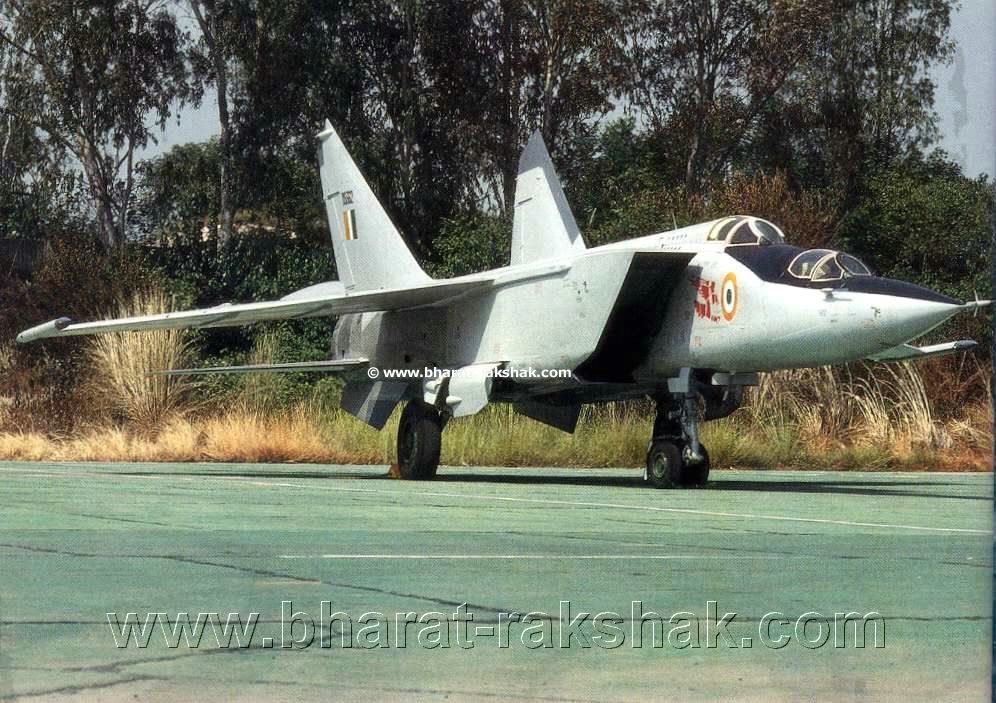
MiG 29 In Indian Service :
India was the first international customer of the MiG-29. The
Indian Air Force
(IAF) placed an order for more than 50 MiG-29s in 1980 while the
aircraft was still in its initial development phase. Since its induction
into the IAF in 1985, the aircraft has undergone a series of
modifications with the addition of new avionics, sub-systems, turbofan
engines and radars. The upgraded Indian version is known as
Baaz (
Hindi for
Hawk) and forms a crucial component of the second-line offensive aircraft-fleet of the IAF after the
Sukhoi Su-30MKI.
Indian MiG-29s were used extensively during the 1999
Kargil War in
Kashmir by the Indian Air Force to provide fighter escort for
Mirage 2000s, which were attacking targets with
laser-guided bombs. According to Indian sources, two MiG-29s from the IAF's No. 47 squadron (Black Archers) gained
missile lock on two F-16s of the
Pakistan Air Force (PAF)
which were patrolling close to the border to prevent any incursions by
Indian aircraft, but did not engage them because no official declaration
of war had been issued. The Indian MiG-29s were armed with
beyond-visual-range air-to-air missiles whereas the Pakistani F-16s were
not.
The MiG-29’s good operational record prompted India to sign a deal
with Russia in 2005—2006 to upgrade all of its MiG-29s for
US$888 million. Under the deal, the Indian MiGs were modified to be
capable of deploying the R-77RVV-AE (AA-12 'Adder') air-to-air missile,
also known as the
Amraamski. The missiles had been successfully
tested in October 1998 and were integrated into IAF's MiG-29s. IAF has
also awarded the MiG Corporation another US$900 million contract to
upgrade all of its 69 operational MiG-29s. These upgrades will include a
new avionics fit, with the N-109 radar being replaced by a Phazatron
Zhuk-M
radar. The aircraft is also being equipped to enhance
beyond-visual-range combat ability and for air-to-air refuelling to
increase endurance.
In 2007, Russia also gave India’s
Hindustan Aeronautics Limited (HAL) a licence to manufacture 120
RD-33 series 3 turbofan engines for the upgrade.
[31] The upgrade will also include a new weapon control system, cockpit
ergonomics,
air-to-air missiles, high-accuracy air-to-ground missiles and "smart"
aerial bombs. The first six MiG-29s will be upgraded in Russia while the
remaining 63 MiGs will be upgraded at the HAL facility in India. India
also awarded a multi-million dollar contract to
Israel Aircraft Industries to provide avionics and subsystems for the upgrade
.
In March 2009, the Indian Air Force expressed concern after 90 MiG-29s were grounded in Russia.
[33] After carrying out an extensive inspection, the IAF cleared all MiG-29s in its fleet in March 2009.
In a disclosure in Parliament, Defence Minister A. K. Antony said the
MiG-29 is structurally flawed in that it has a tendency to develop
cracks due to corrosion in the tail fin. Russia has shared this finding
with India, which emerged after the crash of a Russian Air Force MiG-29
in December 2008. "A repair scheme and preventive measures are in place
and IAF has not encountered major problems concerning the issue," Antony
said.
Despite concerns of Russia's grounding, India sent the first six of its
78 MiG-29s to Russia for upgrades in 2008. The upgrade program will fit
the MiGs with a
phased array radar (PESA) and in-flight re-fuelling capability.
In January 2010, India and Russia signed a US$1.2 billion deal under
which the Indian Navy would acquire 29 additional MiG-29Ks, bringing the
total number of MiG-29Ks on order to 45.
[36] The MiG-29K entered service with the Indian Navy on 19 February 2010.
[37]
The upgrade of all IAF MiG-29 "Baaz" to latest MiG-29SMT standard is in
process, which will include latest avionics, Zhuk-ME Radar, engine,
weapon control systems etc., enhancing multirole capabilities by
many-fold