DISCLAIMER :

Dont believe anything you read, and half of what you see, here !


If a picture doesnt have the blog address as a watermark, it means it was not edited by me. Also we intentionally photoshoped these picture in a low quality photo manipulation, because we dont want anyone to repost this as the truth.

Most of the article are not ours either. We edited it to be match our posts or simply for seo.

Use your common sense to differentiate the truth from hoax.. we sometimes mix it all in.
Showing posts with label india. Show all posts

Wednesday, November 20, 2013

Indian Perspective on China's Export Stealth Fighter J-31

Chinese media reports Quoting Chinese military commentator Lei Ze mentioned how emergence of the Chinese fifth generation J-31 fighter jet will make it difficult for the US to export its F-35 fighters , he also said that Currently, the only fifth generation fighter available for sale is the F-35 by the US. The J-31 will offer an alternative for non-traditional allies of the US.”

Indian Defence analysts Vinayak shetty thinks otherwise and says that it is unlikely that J-31 will affect export sale of F-35, “Many countries are firmly behind F-35 Project, even when Prices have surged upwards recently but it is unlikely any of the current customers will even consider buying Chinese J-31 even if aircraft hits production now” . While J-31 is still in testing phase and good 7 to 8 years before enters production, while F-35 is all set to enter fully fledged Mass production soon.

J-31 Stealth Fighter
While analysts say the Pakistan Air Force (PAF) might be one of the earliest customers of the fighter aircraft, but Vinayak shetty believes it will not be easy for PAF to procure these fighters, PAF are already struggling to buy hand full of J-10 fighters for last few years, even with Soft Loan offer provided by Chinese. PAF on other hand in past were always reluctant to operate twin engine fighter aircraft of medium capability size due to higher operating cost involved.
With No 5th generation fighter aircraft Project coming out of Europe many of these countries will be F-35 operators, and Russian Pak-Fa will capture export orders from traditional Sukhoi 30 / Mig operators in Asia. Traditional Chinese fighter aircraft market (Africa / Asian) countries will struggle to operate 5th generation fighter aircraft, so it will be very difficult for Chinese to push sales in their traditional market and difficult to break into American traditional partners, unless sale is bogged down by Us Export restrictions.
Vinayak shetty also have raised concern about a potential arms race in Asia due to emergence of Chinese J-31, many countries that are neighbours of China and have some unsolved issues with them, might now consider buying expensive F-35 or Pak-fa actually boosting their sales in return.
Currently many countries are also working on their own 5th generation fighter aircraft projects other than Russian, Us and China. India is working on Advanced Medium Combat Aircraft, Japanese on Mitsubishi ATD-X , Turkey on TFX and Russia again on single engine cheaper stealth fighter aircraft based on Mikoyan LMFS , which all might actually eat into J-31 export orders .

IAF never ever considered PAK DA next generation strategic bomber

 Indian air force official have said that , “IAF never ever considered nor did Russians ever presented any proposal on it ” has quoted by a serving IAF official when asked on rumors of India’s interest in PAK-DA development or purchase .

PAK DA (or PAK-DA), is a next generation strategic bomber which is being developed by Russia. It stands for Perspektivnyi Aviatsionnyi Kompleks Dalney Aviatsyi which means Future Air Complex for Strategic Air Forces. The PAK DA is going to be heavily based on Russia’s current supersonic bomber Tupolev Tu-160 and is expected to have it’s maiden flight by 2015. and enter service by 2020-25 time frame .


Currently, the Russian air force has Tu-95 and Tu-160 strategic bombers, as well as long range Tu-22 bombers. Indian Navy is past was interested in renting four Tu-22M bombers , but officially no explanation was given byIndian Navy on backing out, but sources close to idrw.org have told us that high maintenance cost and further expenditure on up-gradation of this aircraft’s which had to be borne by India and it is been also told that Tu-22M on offer where not in best of shape in terms of maintenance and airframe life where possible reason why Indian Navy turned away from this aircraft’s.

Rumors of Indian interest or Russian proposal of PAK-DA sparked of lately when India’s Strategic Nuclear Command requested to have its own separate fighter bombers for nuclear platform , Russian offer or PAK-DA purchase seems to be pure media speculation and doesn’t hold ground . but demand of SNC for immediate purchase of new aircraft’s for this jobs is still under review by Goverment of India .

Thursday, May 3, 2012

Sukhoi Su-30SM: An Indian Gift to Russia’s Air Force


Russia’s Defense Ministry has ordered 30 heavy Sukhoi Su-30SM fighter planes. Given that the same model has been exported to India for more than 10 years, this choice seems both logical and pragmatic.
Thirty 30’s

The Defense Ministry and the Irkut Corporation, an affiliate of the United Aircraft Corporation, have signed a supply contract for 30 Su-30SM multirole fighter aircraft, a Defense Ministry spokesman told journalists Thursday, March 22. “Under the contract, Irkut Corporation will build for Russia’s Ministry of Defense 30 planes of this type by 2015,” he said.

Rumors that Irkut, a long-standing exporter, may supply several dozen fighter aircraft to the Russian Air Force began circulating late last year. Now the rumor has become a reality – a contract in black and white.

But why did the Defense Ministry choose the Su-30’s? After all, they have been mostly supplied to customers abroad rather than to the Russian Armed Forces, where just a few planes of this type are in use.

The Su-30, properly speaking, is an entire family of aircraft and the most famous Russian-made (not to be confused with Soviet-made) fighter plane outside of Russia. It was developed in the Soviet Union on the basis of the Su-27UB combat trainer aircraft as a command plane for Air Defense air regiments flying ordinary Su-27 interceptor aircraft.

In 1993, its export version, the Su-30K, was developed, sparking record demand and the sale of several hundred planes.

The family is further subdivided into two parts: the “Chinese” Su-30MKK/MK2, which were produced in Komsomolsk-on-Amur and exported to Venezuela, Indonesia, Uganda, Vietnam, and of course China; and the “Indian” Su-30MKI, manufactured in Irkutsk and purchased by India, Algeria and Malaysia.

The model ordered by the Russian military is a “localized” version of the “Indian” Su-30MKI. Earlier, Komsomolsk-on-Amur delivered to the Air Force four “localized” Su-30MK2’s.

A flying multi-tasker


As a basic platform for the multirole heavy fighter aircraft, the Su-30MKI is remarkable primarily for its universality. It boasts a so-called “open architecture”, making it relatively easy to add new systems in the basic electronic equipment and to use advanced guided weapons (supplied by different manufacturers).

The Su-30MKI sports a Russian radar and optic locator, French navigation and heads-up display systems, Israeli EW and weapon-guidance systems, and Indian computers.

The “Chinese” line is based on a different logic that prescribes parallel installation of new systems that fall short of full integration.

Most likely, the military is attracted by how easy it is to add different weapons and equipment to the Su-30MKI, transforming it into an attack fighter-bomber, a heavy interceptor aircraft, or something else.

Who placed the order?


It is hard to pinpoint who exactly ordered these 30 aircraft. The contract was signed by Defense Minister Anatoly Serdyukov and Irkut President Alexei Fedorov. After the signing ceremony, Serdyukov commented that the planes would “increase the Air Force’s combat power.”

By contrast, Fedorov went on record as saying last summer that the Defense Ministry was going to order 40 aircraft. Later the press reported, citing the Irkutsk aircraft plant’s general director Alexander Veprev, that the deliveries were likely to be made in two installments: the first 28 aircraft were intended for the Air Force and another 12 as an option for naval aviation. Air Force C-in-C Alexander Zelin confirmed the figure of 28 in fall 2011.

As we can see, the first batch of Sukhoi-30’s has been purchased. The remaining 12, as some military sources intimated to the press, were intended for the Black Sea Fleet’s naval aviation.

Given that naval aviation has seen cuts in combat aircraft, it seems logical to reinforce it with heavy Su-30SM two-seaters that are efficient both in air-to-air combat and against ground and surface targets.

Thus far, however, there is no mention of plans to buy the Su-30 for the Navy. Possibly the option will be realized later.

Exporters’ courtesy


There is another simple explanation for choice of the Su-30MKI. Irkut has been churning out these planes for 10 years thanks to its completely streamlined production method. This means that its products are of high quality, relatively cheap (which pleases the Defense Ministry in particular) and will be supplied on time.

It is one thing if, in order to make 30 aircraft, you have to breathe life into an idling plant, to fine-tune (or develop anew) your technological method, buy additional equipment, and – still worse – hire personnel. But it’s quite another if you have been manufacturing standardized aircraft for years and years and can easily divert your workforce to produce an “improved” modification for your own country’s Air Force. The cost of this batch on the side is dramatically lower.

This approach (buying quickly and on the cheap what can be produced immediately) has been growing in popularity in the Russian military. We have mentioned the Su-30M2 combat trainer aircraft intended for the Russian Air Force. The same goes for the carrier-based MiG-29K, which in its present form was developed for the Indian Navy.

This approach is logical in its own way. The military expects certain fundamentally new models that are being tested with some degree of success. The Air Force is eying the T-50, the fifth-generation fighter aircraft, and the Navy has been trying to get into shape its Lada project involving the construction of non-nuclear submarines. The Land Forces have boycotted the purchases of all currently existing armor models, urging manufacturers to invent something totally new.

In the meantime, the Armed Forces will buy cheap, mass-produced, well-equipped, if ordinary, military hardware, like the Su-30SM.


Source: Konstantin Bogdanov, RIA Novosti military analyst / RIA Novosti News - March 23, 2012 (en.rian.ru)

Photo: Sukhoi Su-30MKI (Flanker-H) multirole fighter (© RIA Novosti. Maya Mashatina)


(3/23/2012)

Thursday, February 23, 2012

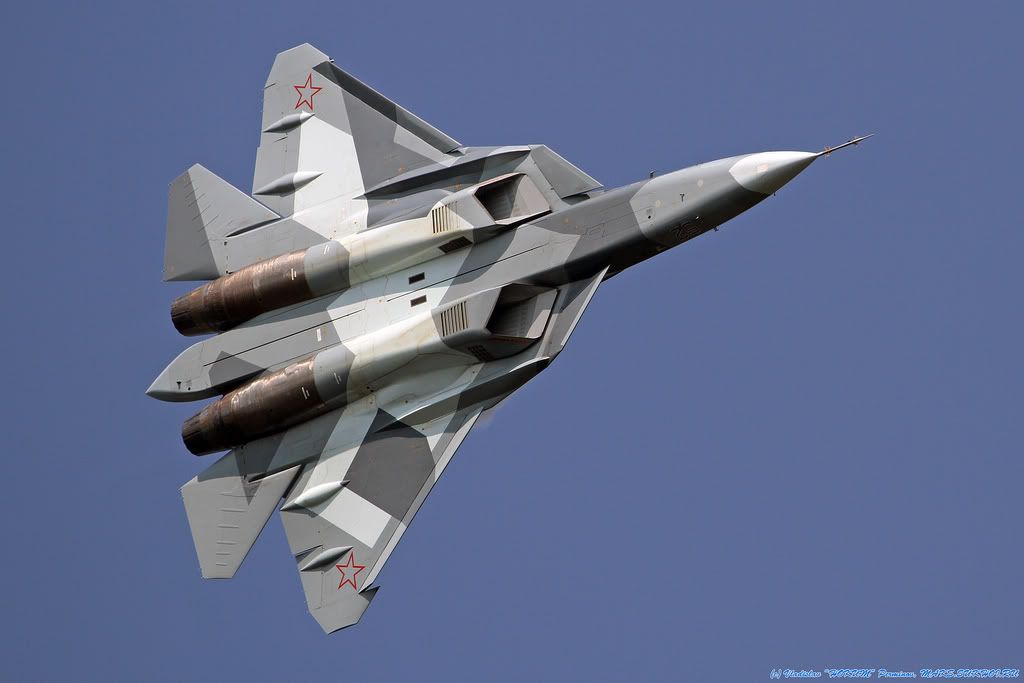
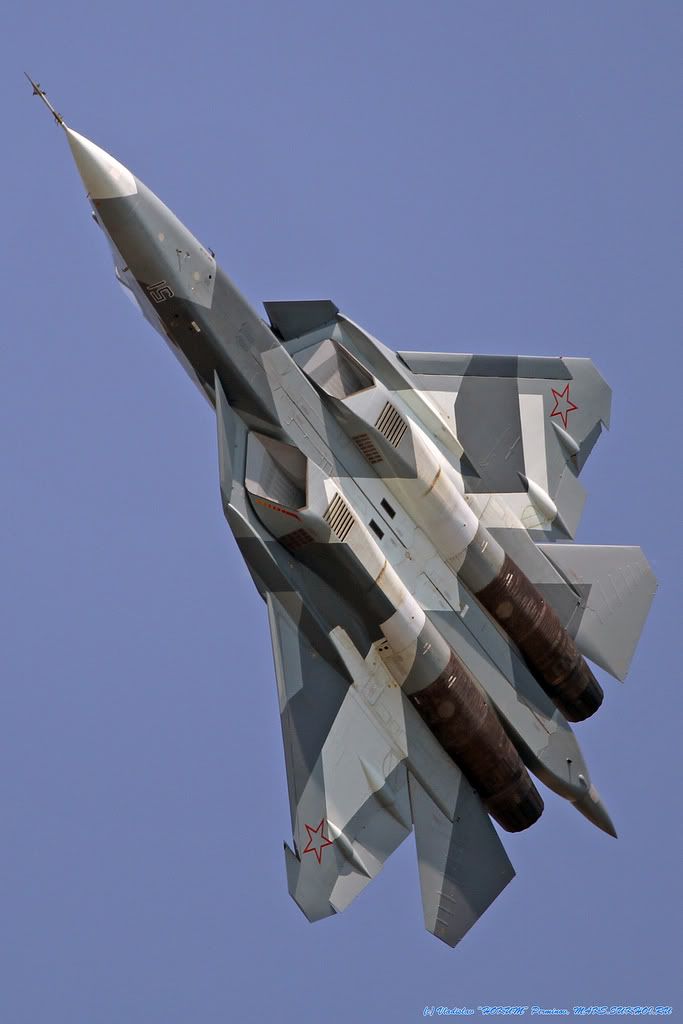
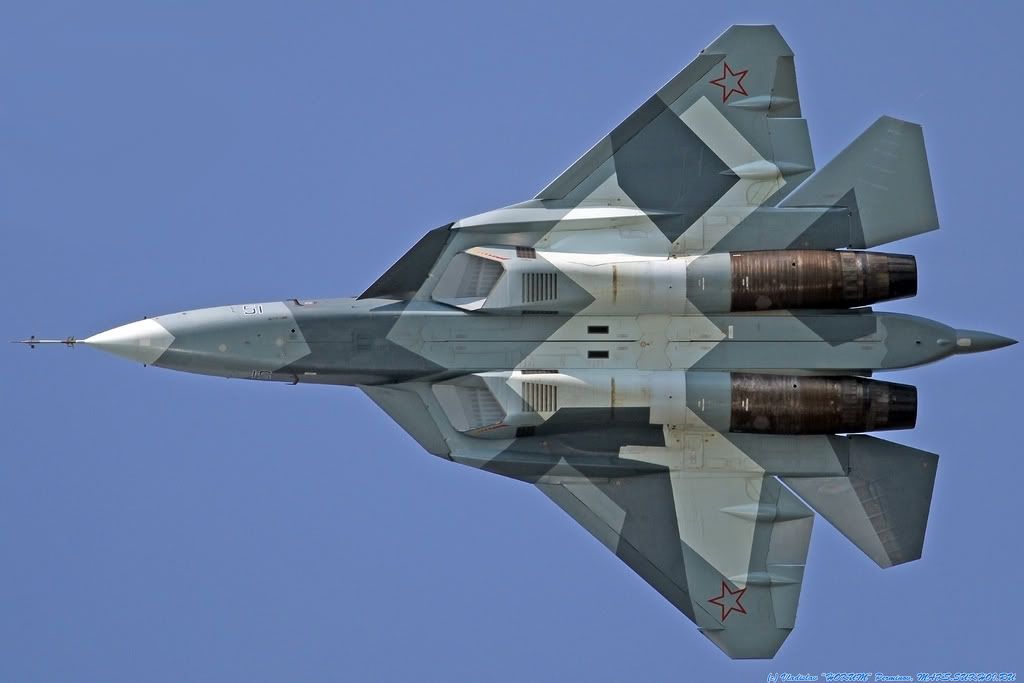
Sukhoi Pak-Fa under-carriage photos

The PAK FA, when fully developed, is intended to be the successor to the MiG-29and Su-27 in the Russian inventory and serve as the basis of the Sukhoi/HAL FGFAbeing developed with India.[14][15] A fifth generation jet fighter, the T-50 performed its first flight 29 January 2010.[3][16] Its second flight was on 6 February and its third on 12 February 2010. As of 31 August 2010, it had made 17 flights and by mid-November, 40 in total. The second prototype was to start its flight test by the end of 2010, but this was delayed until March 2011.[

Thursday, February 2, 2012

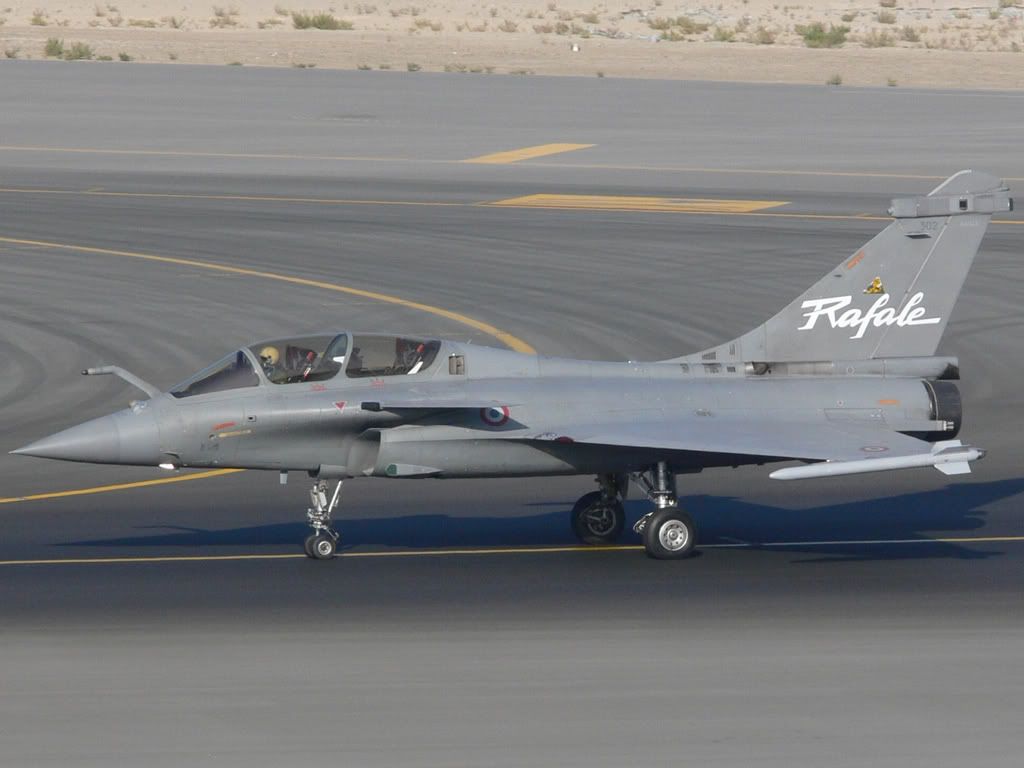
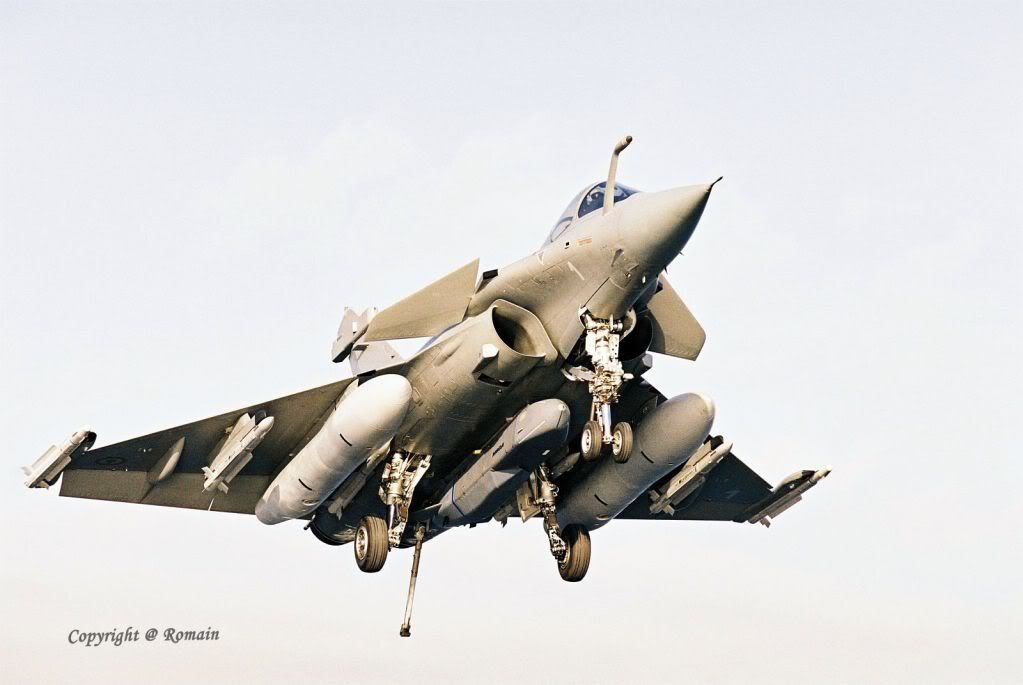
French jet Rafale bags $20bn IAF fighter order

French jet Rafale bags $20bn IAF fighter order; India 'briefs' losing European countries

The Rafale jets will replace India's ageing fleet of Russian MiGs, with the French company entering exclusive talks with the Indians to finalise the deal by March


NEW DELHI: First, the Americans, Russians and Swedes were ejected out of the hotly-contested race. And now, the Europeans too have been shot down in the dogfight, leaving only the French flying high in the Indian skies.
After an exhaustive technical and commercial evaluation spread over five long years, India on Tuesday selected French jet Rafale over the Eurofighter Typhoon for the gigantic almost $20 billion MMRCA ( medium multi-role combat aircraft) programme to supply 126 fighters to IAF - the largest such "open-tender" military aviation deal in the world.

Tuesday, January 3, 2012

LCA Tejas gets to join Air Force


LCA prototype

The 4th generation aircraft is capable of carrying assorted weapon load and can drop tanks up to four tons. It has some of the latest avionics and digital flight control systems.
The LCA though many say is still not 100 per cent ready and the IAF which has long waited for this believes many more tests need to be done before it can be a truly cutting edge machine.
The project, which has taken 27 long years to reach this stage, has been bogged down by technology denials, leading to financial constraints and cost escalations. But with this operational clearance there are now plans to start the Medium Combat Aircraft
However, Defence Minister AK Antony now says that money will not be a problem.
Only a handful of countries can be proud to make their aircraft. The team behind Tejas now hopes that this plane will be a stepping-stone to greater success.

Monday, January 2, 2012

Rafale : Hot favourite for MMRCA


It seems that Indian airforce is more content with Rafale than the Eurofighter, As reported by Deccan Chronicles :

 
Just why has the Indian Air Force (IAF) short-listed the French Rafale and the Eurofighter Typhoon ahead of four other contenders, including the US F-16 and F/A-18 fighters, for the Rs 42, 000 crore medium multi-role combat aircraft (MMRCA) contract?
The down selection at the end of a prolonged evaluation of the six fighter jets was evidently based on the fact that the Rafale and the Typhoon were the most modern airframes and better equipped compared to F/A-18 Super Hornet and F-16 IN of the US, MiG-35 of Russia, and JAS-39 Gripen of Sweden.


The Rafale and the Typhoon met most of the 630 technical attributes mentioned in the request for proposal (RFP) by the ministry of defence, while the others lacked either in performance or had limitations in terms of future upgrades.
“Rafale figures a notch higher than Typhoon in terms of performance and involves easier adaptability as it is logistically and operationally similar to Mirage-2000, used extensively by our boys during the Kargil conflict in 1999. The French government has also cleared the technology transfer, including the AESA (active electronically scanned array) radar,” sources in the IAF told Deccan Chronicle.
The other discreet offering by Dassault Aviation too made sense: save on the $1.5 billion project to upgrade 52 Mirage-2000 jets by acquiring the Rafale.
Interestingly, all six fighters were in the race till April 17, the deadline for submission of modified offset proposals. The representatives of these firms were informed of the Union government’s decision to relax the offset policy mentioned in the request for proposal (RFP).
The original rider that half the value of the $ 10.5 billion contract be passed on to domestic firms was modified, fixing it at 30 per cent of the deal. “We were all expecting a word on extension of commercial proposals on the last day, April 28, but got to know that only Dassault Aviation and Eurofighter have been invited for discussions,” said a representative of Saab AB.
Those who lost out have made it known that they would raise issues concerning the price and other attributes of Rafale and Typhoon. The two aircraft are said to be the highest priced among those in the contest when looked at from a unit price point of view. Second, the Eurofighter’s AESA radar is still under development. Only the two US fighters have operational AESA radars on them.
If India finally picks the Rafale, it would be only the second air force after the French Air Force to induct these fighters into its fleet.
India has asked Dassault SA and Eurofighter GmbH to hold their price bids until the end of the year. The deal is expected to be signed by March 2012.
The Final Two
Eurofighter Typhoon – Germany/Britain/Italy/Spain
Dassault Rafale -- France
Out of the contest
Lockheed Martin’s F-16IN – USA
Boeing’s F/A-18 Super Hornet – USA
SAAB’s Gripen JAS-39 – Sweden
Mikoyan-Gureywich’s MiG-35 – Russia

Saturday, December 31, 2011

MMRCA, JF-17 bought by Pakistan could speed up the Indian deal

Aviation week reports that a quick order of JF-17 fighter jets by Pakistan could be the cause of the soudain hurry surrounding the MMRCA deal.
"India wants to expedite the deal in part because Pakistan is expecting a speedy delivery of 50 JF-17 aircraft, which originally were to be spread out over two years, according to defense ministry officials."

Accordind to Aviation weeks, the offset negociations would have already been initiated

“The negotiation for crucial commercial terms will begin next month,” says Michael Christie, senior vice president at BAE Systems India. BAE is part of the Eurofighter consortium, along with Alenia Aeronautica and EADS. 

In the meatime, French Defense Minister Gerard longuet will meet his Indian counterpart, Mr. AK Antony, Thursday 26th. For sure the Rafale proposal and the Mirage 2000 upgrade will be at the heart of the debates. So everything seems to converge toward a quick decision on which fighter (Rafale or Typhoon) will be chosen.. even if the final deal is not expected to be signed before the end of 2011

Friday, December 30, 2011

Pak-Fa Stealth Fighter Gallery 1


The Sukhoi PAK FA (RussianПерспективный авиационный комплекс фронтовой авиацииPerspektivny aviatsionny kompleks frontovoy aviatsii, literally "Prospective Airborne Complex of Frontline Aviation") is a twin-engine jet fighter being developed by Sukhoi OKB for the Russian Air Force. The Sukhoi T-50 is the prototype for PAK FA.[12] The PAK FA is one of only a handful of stealth jet programs globally.[13]
The PAK FA, when fully developed, is intended to be the successor to the MiG-29and Su-27 in the Russian inventory and serve as the basis of the Sukhoi/HAL FGFAbeing developed with India.[14][15] A fifth generation jet fighter, the T-50 performed its first flight 29 January 2010.[3][16] Its second flight was on 6 February and its third on 12 February 2010. As of 31 August 2010, it had made 17 flights and by mid-November, 40 in total. The second prototype was to start its flight test by the end of 2010, but this was delayed until March 2011.[17][18][19][20][21]
Sukhoi director Mikhail Pogosyan has projected a market for 1,000 aircraft over the next four decades, which will be produced in a joint venture with India, 200 each for Russia and India and 600 for other countries.[22] He has also said that the Indian contribution would be in the form of joint work under the current agreement rather than as a joint venture.[23] The Indian Air Force will "acquire 50 single-seater fighters of the Russian version" before the two seat FGFA is developed.[24] The Russian Defense Ministry will purchase the first 10 aircraft after 2012 and then 60 after 2016.[25][26] The first batch of fighters will be delivered with current technology engines.[27] Ruslan Pukhov, director of the Centre for Analysis of Strategies and Technologies, has projected that Vietnam will be the second export customer for the fighter.[28] The PAK-FA is expected to have a service life of about 30–35 years.

Sukhoi PAK-FA : 3rd prototype flies


MAKING ITS maiden flight from Komsomolsk-on-Amur on November 22 was the third prototype of the Sukhoi T-50/PAK FA fifth-generation fighter. The aircraft, flown by test pilot Sergey Bogdan, was airborne for just over an hour before landing back at the KNAAPO factory airfield.
The flight was deemed a success, with all tests of stability and evaluation of engine performance proceeding as planned. The pilot reported reliable operation of all systems and components.
Maiden flight of the first prototype took place on January 29, 2010, also at Komsomolsk-on-Amur, followed by the second aircraft on March 3, 2011. Both prototypes made their public debut at the MAKS 2011 International Aviation and Space Salon in Zhukovsky, Moscow. The aircraft have now completed more than 100 test flights.

LinkWithin

Related Posts Plugin for WordPress, Blogger...