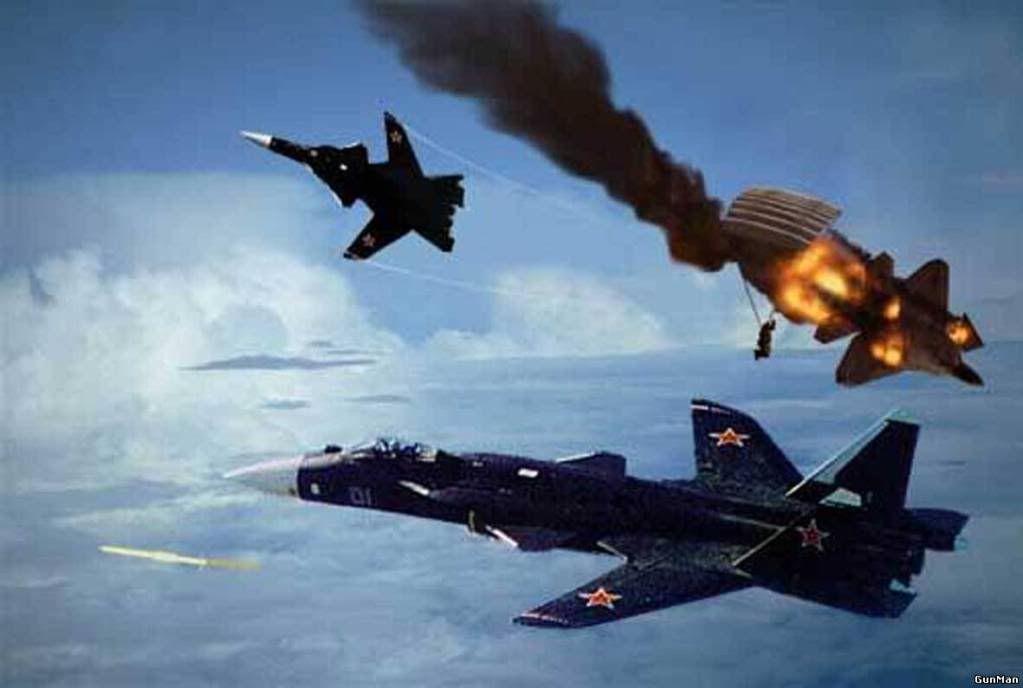
Deadly Russian Sukhoi T50 PAK FA | The Sukhoi PAK FA or Perspektivny aviatsionny Kompleks frontovoy aviatsii, literally "Prospective Airborne Complex Frontline Aviation fjhis a twin-engine jet fighter developed by Sukhoi OKB for the Russian Air Force. The Sukhoi T-50 is the prototype of the PAK FA. PAH FA is one of only a handful of stealth jet programs worldwide. Sukhoi director Mikhail Pogosyan has projected a market for 1,000 aircraft over the next four decades, which will be produced in a joint venture with India, Russia and India each for 200 and 600 for others.
The
PAK FA, when fully developed, is intended to succeed the MiG-29 and
Su-27 in the Russian inventory and as the basis of the Sukhoi / HAL FGFA
be developed with India to serve. A fifth-generation fighter, the T-50 has its first flight January 29, 2010. The second flight was on February 6 and the third on February 12, 2010. As of August 31, 2010 had made 17 flights and mid-November, 40 in total. The second prototype was to begin his flight to test the end of 2010, but this was postponed until March 2011.
Sukhoi director Mikhail Pogosyan has projected a market for 1,000 aircraft over the next four decades, which will be produced in a joint venture with India, Russia and India each for 200 and 600 for others. He also said that India's contribution would be in the form of joint work under the current contract rather than as a joint venture. The Indian Air Force "to acquire 50 single-seater fighters of the Russian version" for the two-seater FGFA developed. The Russian Ministry of Defence will purchase aircraft from October 1st 2012, and 60 after 2016. The first batch of fighters comes with the current technology engines. Ruslan Pukhov, director of the Center for Analysis of Strategies and Technologies, has predicted that Vietnam will be the second export customer for the fighter. The PAK-FA is expected to be a lifetime of about 30-35 years.
He
also said that India's contribution would be in the form of joint work
under the current contract rather than as a joint venture. Sukhoi director Mikhail Pogosyan has projected a market for 1,000 aircraft over the next four decades, which will be produced in a joint venture with India, Russia and India each for 200 and 600 for others. He also said that India's contribution would be in the form of joint work under the current contract rather than as a joint venture. The Indian Air Force "to acquire 50 single-seater fighters of the Russian version" for the two-seater FGFA developed. The Russian Ministry of Defence will purchase aircraft from October 1st 2012, and 60 after 2016. The first batch of fighters comes with the current technology engines. Ruslan Pukhov, director of the Center for Analysis of Strategies and Technologies, has predicted that Vietnam will be the second export customer for the fighter. The PAK-FA is expected to be a lifetime of about 30-35 years.
The
PAK FA, when fully developed, is intended to succeed the MiG-29 and
Su-27 in the Russian inventory and as the basis of the Sukhoi / HAL FGFA
be developed with India to serve. A fifth-generation fighter, the T-50 has its first flight January 29, 2010. The second flight was on February 6 and the third on February 12, 2010. As of August 31, 2010 had made 17 flights and mid-November, 40 in total. The second prototype was to begin his flight to test the end of 2010, but this was postponed until March 2011.
Sukhoi director Mikhail Pogosyan has projected a market for 1,000 aircraft over the next four decades, which will be produced in a joint venture with India, Russia and India each for 200 and 600 for others. He also said that India's contribution would be in the form of joint work under the current contract rather than as a joint venture. The Indian Air Force "to acquire 50 single-seater fighters of the Russian version" for the two-seater FGFA developed. The Russian Ministry of Defence will purchase aircraft from October 1st 2012, and 60 after 2016. The first batch of fighters comes with the current technology engines. Ruslan Pukhov, director of the Center for Analysis of Strategies and Technologies, has predicted that Vietnam will be the second export customer for the fighter. The PAK-FA is expected to be a lifetime of about 30-35 years.
The Indian Air Force "to acquire 50 single-seater fighters of the Russian version" for the two-seater FGFA developed. dfhgdfhgdghGeneral characteristicsSukhoi director Mikhail Pogosyan has projected a market for 1,000 aircraft over the next four decades, which will be produced in a joint venture with India, Russia and India each for 200 and 600 for others. He also said that India's contribution would be in the form of joint work under the current contract rather than as a joint venture. The Indian Air Force "to acquire 50 single-seater fighters of the Russian version" for the two-seater FGFA developed. The Russian Ministry of Defence will purchase aircraft from October 1st 2012, and 60 after 2016. The first batch of fighters comes with the current technology engines. Ruslan Pukhov, director of the Center for Analysis of Strategies and Technologies, has predicted that Vietnam will be the second export customer for the fighter. The PAK-FA is expected to be a lifetime of about 30-35 years.
Crew: 1
Length: 19.8 m (65.9 ft)
Wingspan: 14 m (46.6 ft)
Height: 6.05 m (19.8 ft)
Wing area: 78.8 m2 (848.1 ft2)
Empty weight: 18,500 kg (40,785 lbs)
Loaded weight: 26,000 kg (57,320 lbs)
Payload: 7,500 kg (combat load) (£ 16,534)
Max takeoff weight: 37,000 kg (81,570 lbs)
Powerplant: 2 × anonymous New motor NPO Saturn and MMPP Salyut FNPTS of 175 kN each. Prototype with AL-41F1 of 147 kN each, the final version with new engine> 157 kN
Maximum Fuel Weight: 10,300 kg (22,711 lbs)The Russian Ministry of Defence will purchase aircraft from October 1st 2012, and 60 after 2016. Deadly Russian Sukhoi T50 PAK FA | The Sukhoi PAK FA or Perspektivny aviatsionny Kompleks frontovoy aviatsii, literally "Prospective Airborne Complex Frontline Aviation is a twin-engine jet fighter developed by Sukhoi OKB for the Russian Air Force. The Sukhoi T-50 is the prototype of the PAK FA. PAH FA is one of only a handful of stealth jet programs worldwide.The first batch of fighters comes with the current technology engines. Deadly Russian Sukhoi T50 PAK FA | The Sukhoi PAK FA or Perspektivny aviatsionny Kompleks frontovoy aviatsii, literally "Prospective Airborne Complex Frontline Aviation is a twin-engine jet fighter developed by Sukhoi OKB for the Russian Air Force. The Sukhoi T-50 is the prototype of the PAK FA. PAH FA is one of only a handful of stealth jet programs worldwide.Deadly Russian Sukhoi T50 PAK FA | The Sukhoi PAK FA or Perspektivny aviatsionny Kompleks frontovoy aviatsii, literally "Prospective Airborne Complex Frontline Aviation is a twin-engine jet fighter developed by Sukhoi OKB for the Russian Air Force. The Sukhoi T-50 is the prototype of the PAK FA. PAH FA is one of only a handful of stealth jet programs worldwide.Deadly Russian Sukhoi T50 PAK FA | The Sukhoi PAK FA or Perspektivny aviatsionny Kompleks frontovoy aviatsii, literally "Prospective Airborne Complex Frontline Aviation is a twin-engine jet fighter developed by Sukhoi OKB for the Russian Air Force. The Sukhoi T-50 is the prototype of the PAK FA. PAH FA is one of only a handful of stealth jet programs worldwide. Ruslan Pukhov, director of the Center for Analysis of Strategies and Technologies, has predicted that Vietnam will be the second export customer for the fighter. The PAK-FA is expected to be a lifetime of about 30-35 years.