DISCLAIMER :

Dont believe anything you read, and half of what you see, here !


If a picture doesnt have the blog address as a watermark, it means it was not edited by me. Also we intentionally photoshoped these picture in a low quality photo manipulation, because we dont want anyone to repost this as the truth.

Most of the article are not ours either. We edited it to be match our posts or simply for seo.

Use your common sense to differentiate the truth from hoax.. we sometimes mix it all in.
Showing posts with label Russian Air Force. Show all posts

Thursday, November 28, 2013

Russian Air Force Ready To Get 100 Su-35 & Su-34 By 2015

The Russian Air Force will receive up to 100 Sukhoi fighter jets by 2015, the Defense Ministry spokesman said on Sunday.
Three state contracts with the Sukhoi design bureau on the supply of the jets have been already signed, Vladimir Drik said.
Fifty advanced Su-35 Flanker-E multirole fighters, billed as "4++ generation using fifth-generation technology," more than ten advanced Su-27SM Flanker multirole jets and five Su-30M2 Flanker-C multirole fighters are among the aircraft to be supplied.
The Russian Air Force will also receive twenty-five new Su-34 Fullback fighter-bombers in the next few years, the spokesman said.

China Preparing To Sign Contract of Su-35 Fighter Jet From Russia


Su-35 Multi-Role Fighter


Russia will supply a series of new multirole fights, Su-35, to China in compliance with a contract, which should be prepared by the yearend, an official of the Russian Federal Service for Military-Technical Cooperation told Itar-Tass on Monday.

“A decision to supply the Su-35 fighters to China was taken long ago. The parties work hard to coordinate financial and technical conditions of the future contract, which is due to be prepared by the yearend. At present, the details of the contract are being specified. Upcoming supplies of the Su-35 fighters to China are ‘an open secret’. It is not clear yet what none talks about it in public,” the official said.

Russia Will Deliver Su-35 Fighters And S-400 Triumph Air Defense Systems To China


Su-35

Su-35
 China hopes to acquire new Russian S-400 Triumph air defense system by 2015, but only the question of delivery of Su-35 fighters to this country is being discussed at the moment, Rossiyskaya Gazeta reports.

"The Chinese party has shown interest in acquisition of a number of Su-35 jets and submitted a proposal to us in 2011. At present this problem is being elaborated by the designated institution of Russia", - said the First Deputy Director General of Federal Service of Military-Technical Cooperation, Alexander Fomin.

Speaking of prospects of air defense systems deliveries to China, Fomin has reminded that during a period from 1993 to 2010 a large number of Russian air defense missile systems, including S-300PMU2 “Favorit”, have been delivered to China.

"As for further cooperation with China in the area of air defense, at present the Chinese partners are showing interest in acquisition of next-generation S-400 Triumph air defense systems. They want to acquire the first batch in 2015", - Fomin said.

Thursday, May 3, 2012

Sukhoi Su-30SM: An Indian Gift to Russia’s Air Force


Russia’s Defense Ministry has ordered 30 heavy Sukhoi Su-30SM fighter planes. Given that the same model has been exported to India for more than 10 years, this choice seems both logical and pragmatic.
Thirty 30’s

The Defense Ministry and the Irkut Corporation, an affiliate of the United Aircraft Corporation, have signed a supply contract for 30 Su-30SM multirole fighter aircraft, a Defense Ministry spokesman told journalists Thursday, March 22. “Under the contract, Irkut Corporation will build for Russia’s Ministry of Defense 30 planes of this type by 2015,” he said.

Rumors that Irkut, a long-standing exporter, may supply several dozen fighter aircraft to the Russian Air Force began circulating late last year. Now the rumor has become a reality – a contract in black and white.

But why did the Defense Ministry choose the Su-30’s? After all, they have been mostly supplied to customers abroad rather than to the Russian Armed Forces, where just a few planes of this type are in use.

The Su-30, properly speaking, is an entire family of aircraft and the most famous Russian-made (not to be confused with Soviet-made) fighter plane outside of Russia. It was developed in the Soviet Union on the basis of the Su-27UB combat trainer aircraft as a command plane for Air Defense air regiments flying ordinary Su-27 interceptor aircraft.

In 1993, its export version, the Su-30K, was developed, sparking record demand and the sale of several hundred planes.

The family is further subdivided into two parts: the “Chinese” Su-30MKK/MK2, which were produced in Komsomolsk-on-Amur and exported to Venezuela, Indonesia, Uganda, Vietnam, and of course China; and the “Indian” Su-30MKI, manufactured in Irkutsk and purchased by India, Algeria and Malaysia.

The model ordered by the Russian military is a “localized” version of the “Indian” Su-30MKI. Earlier, Komsomolsk-on-Amur delivered to the Air Force four “localized” Su-30MK2’s.

A flying multi-tasker


As a basic platform for the multirole heavy fighter aircraft, the Su-30MKI is remarkable primarily for its universality. It boasts a so-called “open architecture”, making it relatively easy to add new systems in the basic electronic equipment and to use advanced guided weapons (supplied by different manufacturers).

The Su-30MKI sports a Russian radar and optic locator, French navigation and heads-up display systems, Israeli EW and weapon-guidance systems, and Indian computers.

The “Chinese” line is based on a different logic that prescribes parallel installation of new systems that fall short of full integration.

Most likely, the military is attracted by how easy it is to add different weapons and equipment to the Su-30MKI, transforming it into an attack fighter-bomber, a heavy interceptor aircraft, or something else.

Who placed the order?


It is hard to pinpoint who exactly ordered these 30 aircraft. The contract was signed by Defense Minister Anatoly Serdyukov and Irkut President Alexei Fedorov. After the signing ceremony, Serdyukov commented that the planes would “increase the Air Force’s combat power.”

By contrast, Fedorov went on record as saying last summer that the Defense Ministry was going to order 40 aircraft. Later the press reported, citing the Irkutsk aircraft plant’s general director Alexander Veprev, that the deliveries were likely to be made in two installments: the first 28 aircraft were intended for the Air Force and another 12 as an option for naval aviation. Air Force C-in-C Alexander Zelin confirmed the figure of 28 in fall 2011.

As we can see, the first batch of Sukhoi-30’s has been purchased. The remaining 12, as some military sources intimated to the press, were intended for the Black Sea Fleet’s naval aviation.

Given that naval aviation has seen cuts in combat aircraft, it seems logical to reinforce it with heavy Su-30SM two-seaters that are efficient both in air-to-air combat and against ground and surface targets.

Thus far, however, there is no mention of plans to buy the Su-30 for the Navy. Possibly the option will be realized later.

Exporters’ courtesy


There is another simple explanation for choice of the Su-30MKI. Irkut has been churning out these planes for 10 years thanks to its completely streamlined production method. This means that its products are of high quality, relatively cheap (which pleases the Defense Ministry in particular) and will be supplied on time.

It is one thing if, in order to make 30 aircraft, you have to breathe life into an idling plant, to fine-tune (or develop anew) your technological method, buy additional equipment, and – still worse – hire personnel. But it’s quite another if you have been manufacturing standardized aircraft for years and years and can easily divert your workforce to produce an “improved” modification for your own country’s Air Force. The cost of this batch on the side is dramatically lower.

This approach (buying quickly and on the cheap what can be produced immediately) has been growing in popularity in the Russian military. We have mentioned the Su-30M2 combat trainer aircraft intended for the Russian Air Force. The same goes for the carrier-based MiG-29K, which in its present form was developed for the Indian Navy.

This approach is logical in its own way. The military expects certain fundamentally new models that are being tested with some degree of success. The Air Force is eying the T-50, the fifth-generation fighter aircraft, and the Navy has been trying to get into shape its Lada project involving the construction of non-nuclear submarines. The Land Forces have boycotted the purchases of all currently existing armor models, urging manufacturers to invent something totally new.

In the meantime, the Armed Forces will buy cheap, mass-produced, well-equipped, if ordinary, military hardware, like the Su-30SM.


Source: Konstantin Bogdanov, RIA Novosti military analyst / RIA Novosti News - March 23, 2012 (en.rian.ru)

Photo: Sukhoi Su-30MKI (Flanker-H) multirole fighter (© RIA Novosti. Maya Mashatina)


(3/23/2012)

Thursday, February 23, 2012

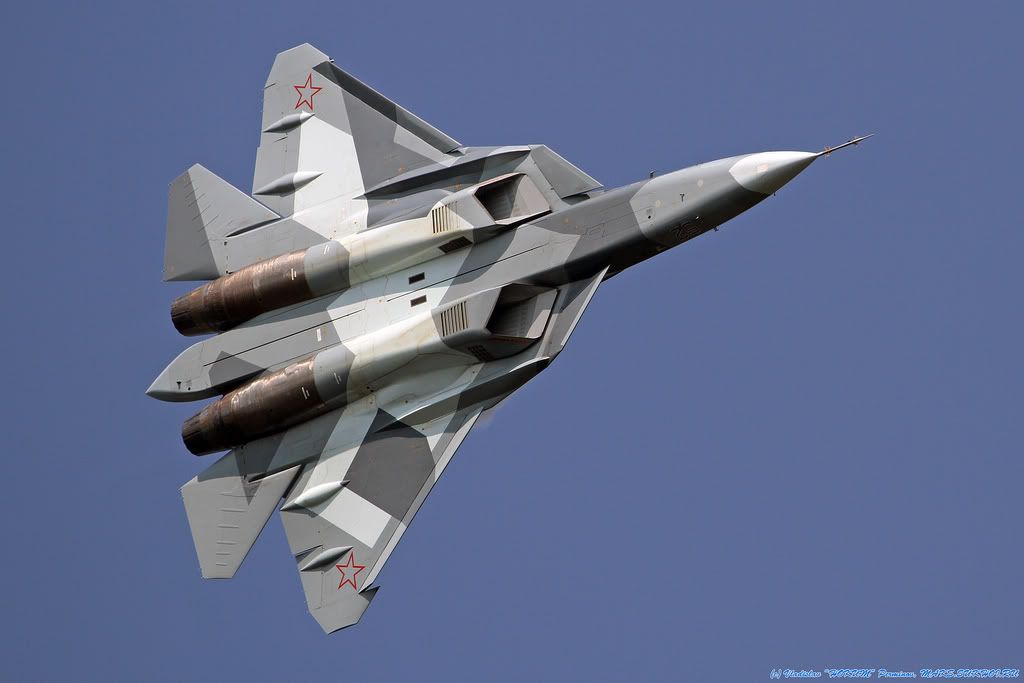
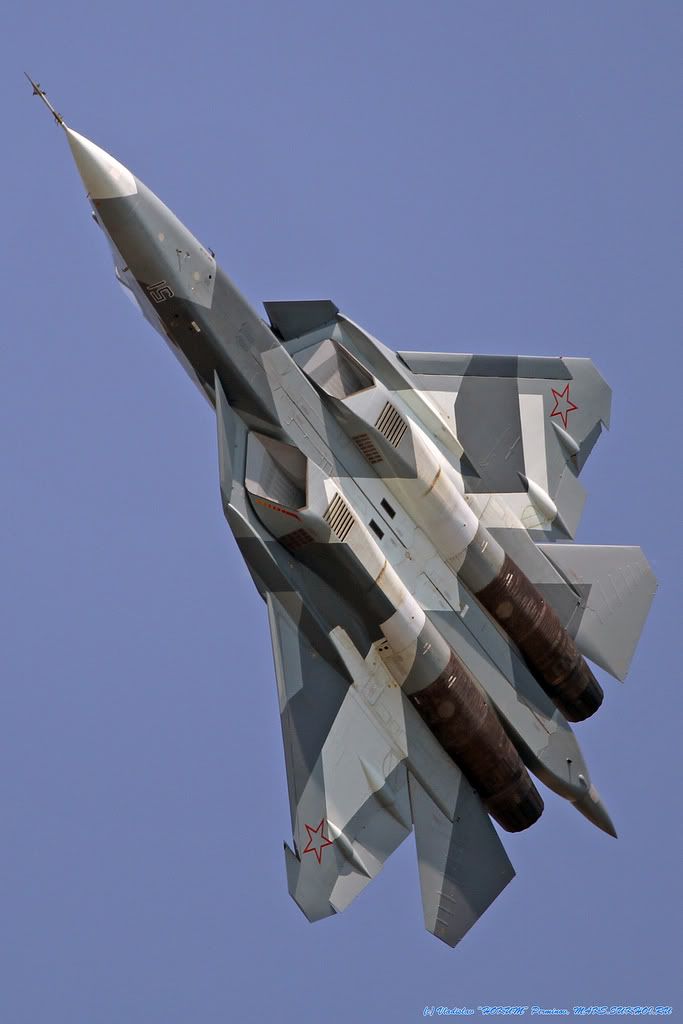
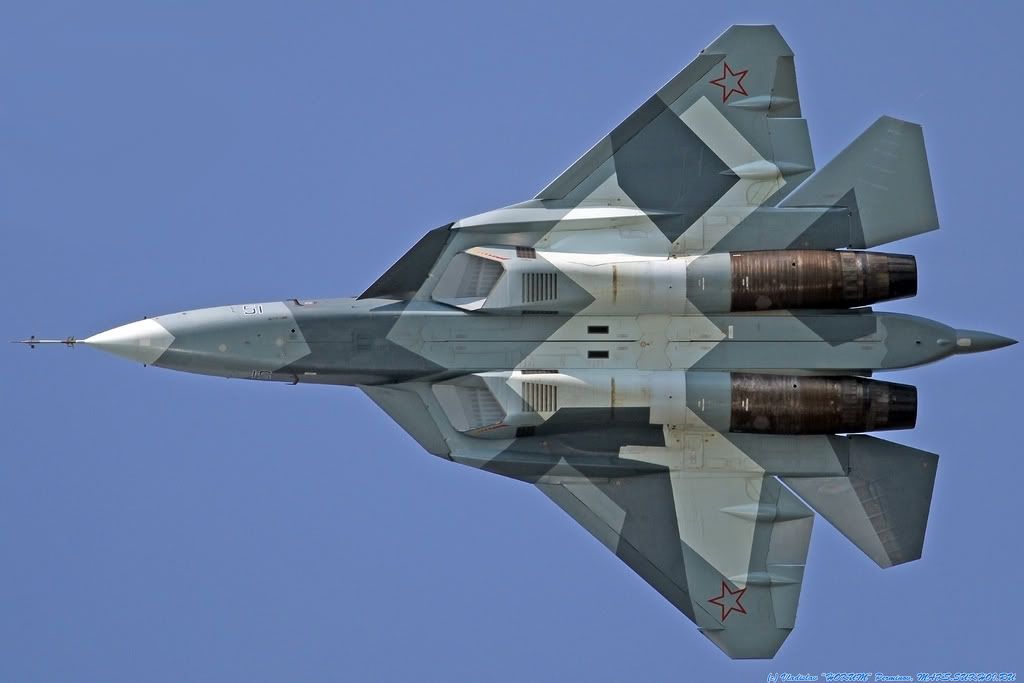
Sukhoi Pak-Fa under-carriage photos

The PAK FA, when fully developed, is intended to be the successor to the MiG-29and Su-27 in the Russian inventory and serve as the basis of the Sukhoi/HAL FGFAbeing developed with India.[14][15] A fifth generation jet fighter, the T-50 performed its first flight 29 January 2010.[3][16] Its second flight was on 6 February and its third on 12 February 2010. As of 31 August 2010, it had made 17 flights and by mid-November, 40 in total. The second prototype was to start its flight test by the end of 2010, but this was delayed until March 2011.[

Saturday, December 31, 2011

Pak-Fa Impact on future USAF

Solomon reminded me that I hadn't commented on reports of the USAF leadership's view of the Sukhoi T-50, the prototype for the Russian PAK-FA future tactical fighter. That's because at first sight I found the statements unremarkable - but then I realized that, in itself, that is worthy of comment.

In the Cold War, you could rely on the Pentagon and the USAF to play up the Soviet threat for all it was worth. The MiG-25? Not only Mach 3 but an agile dogfighter. The Tu-22M Backfire was a B-1 equivalent with the range for strategic attacks against the US. And if you disagreed with the USAF that the nation consequently needed lots of F-15s and B-1s, you were clearly some kind of fluoride-swilling crypto-Commie prevert.

There was actually a running fight between the military intelligence agencies and the CIA, which bypassed the Pentagon and took its data to black-program teams within industry. The most public rumpus was over Backfire, where the boss of USAF intelligence tried to force McDonnell Douglas to recant the conclusions of a CIA-contracted team within the company, whose estimates of the bomber's performance were lower and far more accurate than those of Air Force analysts and the Defense Intelligence Agency.


So it's ironic to see USAF leaders downplaying the potential of the T-50,as in this report from Air Force Times. “I didn’t see anything … that would cause me to rethink plans for the F-22 or F-35,” Air Force Secretary Michael Donley was quoted as saying.  Pacific Air Forces commander Gen. Gary North, added: “I guess the greatest flattery is how much they copy you.”

Donley's comment, of course, is a demonstration of the Mandy Rice-Davies principle in action: He would say that, wouldn't he? His immediate predecessor was canned for (among other things) expressing incorrect and counter-revolutionary sentiments regarding his boss's F-22/F-35 plan. 


Gen. North, meanwhile, is falling into the old technical intelligence trap called mirror-imaging:  we want the B-1, so the Soviets must want a B-1 as well. The PAK-FA's front end bears a superficial resemblance to the F-22, but its hindquarters could not be more different, and - just for starters - it's a reasonable assessment that the Russian concept of balancing stealth with other requirements is very different from that which informed the F-22 design. 

I'm not sure that anyone has an accurate assessment of the PAK-FA threat, in terms of timing, numbers and detailed capability - that will depend on how fast the Russia-India relationship can move things forward, which in turn depends on money, as well as on technical resources. But it is pretty clearly a supercruiser, probably a good one, with some unique features that are there to combine speed and high agility without counter-stealthy aerodynamic surfaces all over the place. 

And had you started thinking about this kind of design in the late 1990s, and if "eating F-35s for breakfast" was on the requirements list, you'd end up with something like T-50. So I'd suggest that writing it off as a me-too F-22 is a bit premature.


By Bill Sweetman 

Friday, December 30, 2011

Pak-Fa Stealth Fighter Gallery 1


The Sukhoi PAK FA (RussianПерспективный авиационный комплекс фронтовой авиацииPerspektivny aviatsionny kompleks frontovoy aviatsii, literally "Prospective Airborne Complex of Frontline Aviation") is a twin-engine jet fighter being developed by Sukhoi OKB for the Russian Air Force. The Sukhoi T-50 is the prototype for PAK FA.[12] The PAK FA is one of only a handful of stealth jet programs globally.[13]
The PAK FA, when fully developed, is intended to be the successor to the MiG-29and Su-27 in the Russian inventory and serve as the basis of the Sukhoi/HAL FGFAbeing developed with India.[14][15] A fifth generation jet fighter, the T-50 performed its first flight 29 January 2010.[3][16] Its second flight was on 6 February and its third on 12 February 2010. As of 31 August 2010, it had made 17 flights and by mid-November, 40 in total. The second prototype was to start its flight test by the end of 2010, but this was delayed until March 2011.[17][18][19][20][21]
Sukhoi director Mikhail Pogosyan has projected a market for 1,000 aircraft over the next four decades, which will be produced in a joint venture with India, 200 each for Russia and India and 600 for other countries.[22] He has also said that the Indian contribution would be in the form of joint work under the current agreement rather than as a joint venture.[23] The Indian Air Force will "acquire 50 single-seater fighters of the Russian version" before the two seat FGFA is developed.[24] The Russian Defense Ministry will purchase the first 10 aircraft after 2012 and then 60 after 2016.[25][26] The first batch of fighters will be delivered with current technology engines.[27] Ruslan Pukhov, director of the Centre for Analysis of Strategies and Technologies, has projected that Vietnam will be the second export customer for the fighter.[28] The PAK-FA is expected to have a service life of about 30–35 years.

LinkWithin

Related Posts Plugin for WordPress, Blogger...