DISCLAIMER :

Dont believe anything you read, and half of what you see, here !


If a picture doesnt have the blog address as a watermark, it means it was not edited by me. Also we intentionally photoshoped these picture in a low quality photo manipulation, because we dont want anyone to repost this as the truth.

Most of the article are not ours either. We edited it to be match our posts or simply for seo.

Use your common sense to differentiate the truth from hoax.. we sometimes mix it all in.
Showing posts with label Chengdu. Show all posts

Friday, December 27, 2013

Chengdu Aircraft Industry designing more advanced J-10C fighter


  • Staff Reporter
  • 2013-12-24
  • 08:55 (GMT+8)
[​IMG]
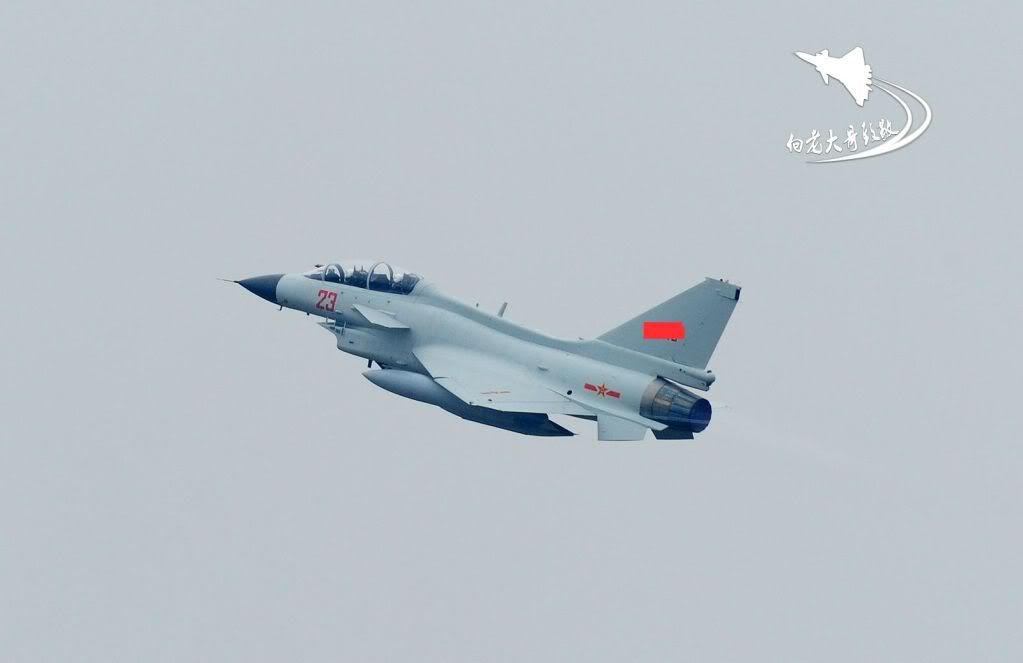
A J-10B prototype takes a test flight. (Internet photo)

The J-10B — the upgrade version of China's J-10 fighter — recently entered service with the People's Liberation Army, with its designer Chengdu Aircraft Industry Group already developing the more advanced J-10C, reports the Hong Kong-based Phoenix Television.

Equipped with an active electronically scanned array radar, Phoenix Television stated that the J-10B has the capability to take out Japan's F-15J fighters if an aerial confrontation were to occur over the disputed Diaoyutai islands (called Senkaku in Japan and Diaoyu in China) in the East China Sea. The fighter is also built with radar absorbent material and better diverterless supersonic inlet, while its stealth capability has also been increased compared to its predecessor, the J-10A.

China is the only nation in the world which has the ability to build its own diverterless supersonic inlet other than the United States, the report said. With this technology, the J-10B is believed to be the best 4.5 generation fighter in the Asia-Pacific region. Its helmet-mounted display system designed for J-10B pilots reacts faster and it is also very similar to the US-built F-16E/F Block 60 and French-built Rafale.

However, the J-10B is primarily designed as a fighter for aerial engagement. A multirole fighter will be needed for China to conduct ground attack missions as well as aerial combat missions against potential enemies in the region and therefore the PLA Air Force and Navy Air Force will need the more advanced J-10C, Phoenix Television said.

------
China's fourth-generation stealth J10C born in Chengdu shock: U.S. imperialism terrified


  Recent U.S. military rebellion: fly into China has developed the latest improved J10 - J10C fighters. The successful development of such fighters as early as expected the U.S. military, because the J10 aircraft from its official public official is already fielded dozens of front-line troops stand much.


  J10C equipped with more advanced radar equipment, the radar has greater than the J10 radar detection range and the ability to simultaneously track 12 targets and hit one of the biggest threats to six goals. Its cockpit is set up more advanced domestic diffraction HUD. In addition J10C In addition equipped with more advanced air to air missiles in the moment PL12 will be equipped with more advanced PL-13 remote air missiles, and this has the ability anti-missile early warning aircraft. The installation of a laser-guided pod J10C, but also to launch a variety of laser-guided bombs, to further improve the precision strike capability against ground fighters.


  J10C and J10 have a large difference in appearance, which uses a more sophisticated inlet design, originally because of the installation of a larger thrust engines designed for six additional bone ribs will cease to exist, replaced by a more streamlined design. In addition to the inlet, the biggest difference J10C and J10 appearance is that, J10C also *** F16E as the installation of a similar "hump Falcon" two king-size fuel tanks.


  In this regard the United States was not surprised that the United States believes J10 fighter design success lies in its fully digested and absorbed the advantages of F16 fighters, so J10C and F16E adopt similar practices designed to increase the range is not surprising. J10 fighter's overall performance has exceeded the F16A / B, and J10C fighter's performance is like with a dial-around as rhenium Shite man, and has exceeded all models F16, one of the main active duty U.S. warplanes. But the U.S. also believes that due to the J10 aircraft engines still have to rely on Russia, so Russia's J10C only uses the latest improved AL-31FN engine.


  The United States further noted J10C the successful development of China's significance lies not only J10C fighter itself, but rather as an important mission to China in its fourth generation fighter validation machines! It is reported that, J10C using stealth coatings, infrared suppression and many other stealth technology to reduce the amount of infrared radiation, and radar reflectivity, and before the U.S. military successfully developed a fourth-generation fighter F35, is also the first in the F16E fighter stealth design validation work carried out, and Russia launched the S-37 Golden Eagle aircraft also served the same task. So J10C successful development indicates that China's fourth-generation fighter JXX true also about to take off!


  Australian air force official blog magazine recently wrote, the exposure of the appearance and performance data of China's carrier-based aircraft J-10C, where landing roll distance reduced to less than 50 meters.


  The article points out that these data show, J-10C carrier-based aircraft and J-10 fighter series are almost identical, only the thrust increased from 122 kN to 152 kN, sliding distance shortened to less than 50 meters. Like with J-10, J-10C in addition to maintaining normal levels of the carrier aircraft flight, there is sufficient force to meet the needs of a variety of combat mission execution, and thus, J-10C acceleration, climbing and have been circled, etc. increased dramatically, even into combat mode vertical rise effortlessly.


  The article said, J-10C carrier-based aircraft operator controlled by a weapon, and is responsible for precision strikes. J-10C can carry 4 tons of ammunition, and the future will be equipped with precision-guided weapons. In addition, the carrier aircraft may also have ground attack capability

Wednesday, November 20, 2013

CAC J-20 no. 2001 prototype photos

The J-20 #2001 prototype was photographed when it was preparing for high-speed taxi trial at the CAC airfield in late December 2010, wearing a distinctive dark green color scheme (RAM coating applied?). The prototype features a pair of all-moving tailfins and Russian 1.44 style ventral stabilizing fins, which shield the engine nozzles but might increase RCS.

It also features an F-22 style forward fuselage, including Caret intakes but with DSI bumps installed at the upper inner corners, as well as a one-piece frameless canopy. However the canards appear to extend slightly above the plane of the main wings and there are four large underwing actuator fairings which might not be stealth optimized. First disclosed by US Office of Naval Intelligence (ONI) in 1997 as XXJ, J-20 is the 4th generation multi-role fighter to enter the service between 2015 and 2018. Since 90s both CAC/611 Institute and SAC/601 Institute had been working their own designs for a twin-engine multi-role heavy fighter with stealth capability and maneuverability comparable to American F-22.


It was speculated that 601 Institute was working on a "tri-plane" design (J-18?) based on canard/conventional layout/V-shape tailfin while 611 Institute working on a design based on canard/tailless delta wing/all moving V-shape tailfin/lateral DSI/bump inlet layout. All designs were expected to feature an internal weapon bay to reduce RCS, which has been speculated to be <0 .05m2="" 1475="" a="" advanced="" aesa="" aircraft="" also="" an="" and="" be="" br="" cockpit="" color="" display="" engine="" expected="" f-35="" fbw="" feature="" fire-control="" fully="" glass="" head-on="" holographic="" hud="" incorporates="" integrated="" is="" its="" j-20="" lcd="" may="" pure="" radar="" single="" system="" systems.="" the="" to="" wide-angle="" with="" ype="">
Many of these subsystems have been tested onboard J-10B to speed up the development (see above). The exact type of engine powering J-20 prototypes is unclear, even though a Russian turbofan engine such as 117S or 99M2 (14t class) or D-30F6 (15t class) with an axisymmetric TVC nozzle has been speculated. It was reported in November 2006 that a T/W=10 17t class turbofan (WS-15/"large thrust") is being developed and will eventually power J-20. Russian assistance was also speculated in terms of software support for calculating the RCS of various designs. The overall performance of J-20 is thought to be superior to that of Russian T-50 (maneuverability & supercruise) but still inferior to that of American F-22 (electronics & supercruise). In August 2008 it was reported that 611 Institute was selected to be the main contractor for the development of J-20 and 601 Institute as the sub-contractor. Subsequently a full-scale metal mockup was built at CAC.


One rumor in May 2010 claimed that 611 Institute started to construct the first prototype, which was expected to fly by the end of 2010, even though the full configuration model won't fly until a few years later. Currently two prototypes (#2001 & 2002) have been constructed and the first high-speed taxi trial by 2001 took place on December 22, 2010.

Indian Perspective on China's Export Stealth Fighter J-31

Chinese media reports Quoting Chinese military commentator Lei Ze mentioned how emergence of the Chinese fifth generation J-31 fighter jet will make it difficult for the US to export its F-35 fighters , he also said that Currently, the only fifth generation fighter available for sale is the F-35 by the US. The J-31 will offer an alternative for non-traditional allies of the US.”

Indian Defence analysts Vinayak shetty thinks otherwise and says that it is unlikely that J-31 will affect export sale of F-35, “Many countries are firmly behind F-35 Project, even when Prices have surged upwards recently but it is unlikely any of the current customers will even consider buying Chinese J-31 even if aircraft hits production now” . While J-31 is still in testing phase and good 7 to 8 years before enters production, while F-35 is all set to enter fully fledged Mass production soon.

J-31 Stealth Fighter
While analysts say the Pakistan Air Force (PAF) might be one of the earliest customers of the fighter aircraft, but Vinayak shetty believes it will not be easy for PAF to procure these fighters, PAF are already struggling to buy hand full of J-10 fighters for last few years, even with Soft Loan offer provided by Chinese. PAF on other hand in past were always reluctant to operate twin engine fighter aircraft of medium capability size due to higher operating cost involved.
With No 5th generation fighter aircraft Project coming out of Europe many of these countries will be F-35 operators, and Russian Pak-Fa will capture export orders from traditional Sukhoi 30 / Mig operators in Asia. Traditional Chinese fighter aircraft market (Africa / Asian) countries will struggle to operate 5th generation fighter aircraft, so it will be very difficult for Chinese to push sales in their traditional market and difficult to break into American traditional partners, unless sale is bogged down by Us Export restrictions.
Vinayak shetty also have raised concern about a potential arms race in Asia due to emergence of Chinese J-31, many countries that are neighbours of China and have some unsolved issues with them, might now consider buying expensive F-35 or Pak-fa actually boosting their sales in return.
Currently many countries are also working on their own 5th generation fighter aircraft projects other than Russian, Us and China. India is working on Advanced Medium Combat Aircraft, Japanese on Mitsubishi ATD-X , Turkey on TFX and Russia again on single engine cheaper stealth fighter aircraft based on Mikoyan LMFS , which all might actually eat into J-31 export orders .

J-10 B is a so-called"fourth and a half" generation fighter

Zhang Jigao, deputy chief designer of the J-10 fighter, spoke about the improved model J-10 publicly for the first time in the AVIC flight test center. Zhang Jigao told People's Daily Online reporters that the overall performance of the J10 will be comprehensively improved in areas such as aerodynamic layout, mission system, and the approach to maintenance. 
In March 2009, pictures of our improved model J10 fighters appeared for the first time on the Internet, and netizens quickly began to call it the "J-10B".

Over the last five 5 years, several images of the test J10B have appeared online,attracting widespread attention from netizens, military enthusiasts, and even foreign media.

U.S. military expert Richard Fisher recently pointed out that the J-10 B is a so-called"fourth and a half" generation fighter equipped with modern airborne technology and advanced radar system, which is about to be delivered to the PLA Air Force.
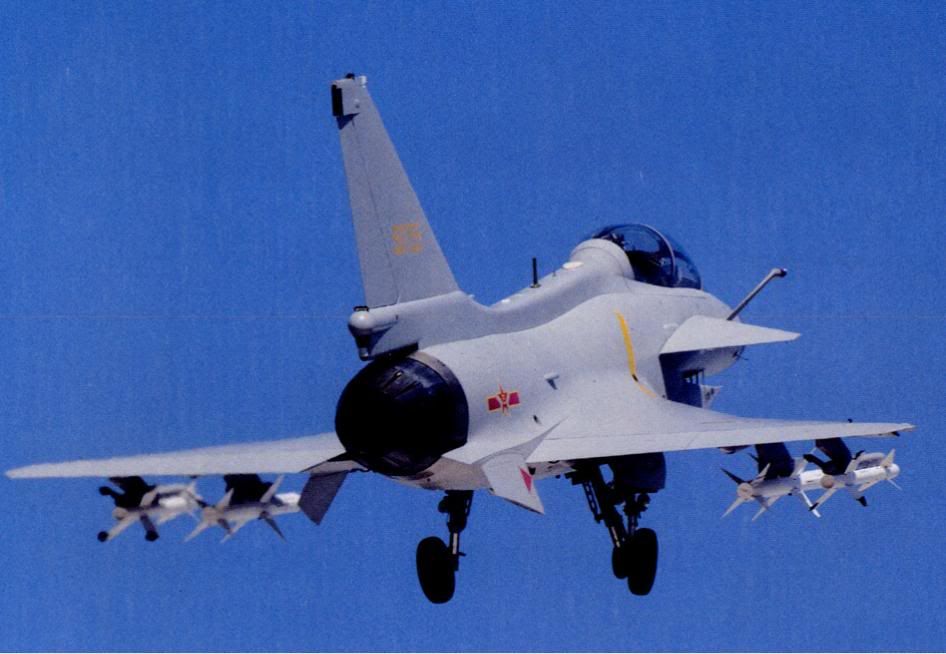
J-10B
J-10B 

Zhang Jigao disputed the term "fourth and a half" generation. In contrast, he suggested that the current international criteria to classify generations are more applicable.
He pointed out that single combat is rare in modern warfare, and that the majority of cases now involve system combat and network operations, so that the combat capabilities of a 
fighter depend on many factors. "This does not mean that the optimization of an aircraft's radar, avionics, and missile detection ranges are bound to improvements in operational performance."

Sunday, April 29, 2012

FC-1/JF-17 gets a new Pod ?

Recently fresh pics have surfaced showing the Jf-17 Prototype 06 at Chengdu  Airforce base flying with a new pod. Many speculations have emerged so forth, some labeling it a new ECM pod like the KG-300 , some say its a new targeting pod similar to WMD-7,   some have guessed it to be an IRST pod while other speculations sat that this is just a camera pod.

The last explanation seems more plausible as this Jf-17 was seen as a chase plane for China new 5th Gen Stealth aircraft, the Chengdu J-20. So most likely it was just up in the air with a camera pod to monitor the flight of J-20 .

Furthermore if you zoom in on the pod at the better resolution pic, i have posted , u will be able to guess the words written on the pod. From what i can make of it, it reads BFSK-01 . A quick search on Google reveals that BFSK and similar terms FSK, ASK etc refer to terminology in Telecommunication Physics. 

An extract of a paper presented at MILITARY COMMUNICATIONS CONFERENCE, 2011 - MILCOM 2011 , says that FSK refers to :
Frequency Shift Keying - Fast Frequency Hopping demodulator, which provides increased resilience to interference with a very slight complexity increase. The additional robustness against jamming is achieved by jointly observing the FSK demodulator branches. This allows the proposed demodulator to distinguish the jammer from the signal more accurately. This demodulator is particularly robust for the case of high J/S (Jammer to Signal Ratio), while for the case of low J/S its performance is in line with state-of-the-art receivers.
  This is also augumented by the fact that the pod in question had a UHF antenna popping out. This might give credence to the theory that the pod is actually a camera with secure frequency hopping , jam resistant radio communication device as the FC-1/JF-17 is being used as a chase plane for China's top secret Jet . But who knows, i may be wrong as this is just guess work as i am no expert.

Thursday, April 5, 2012

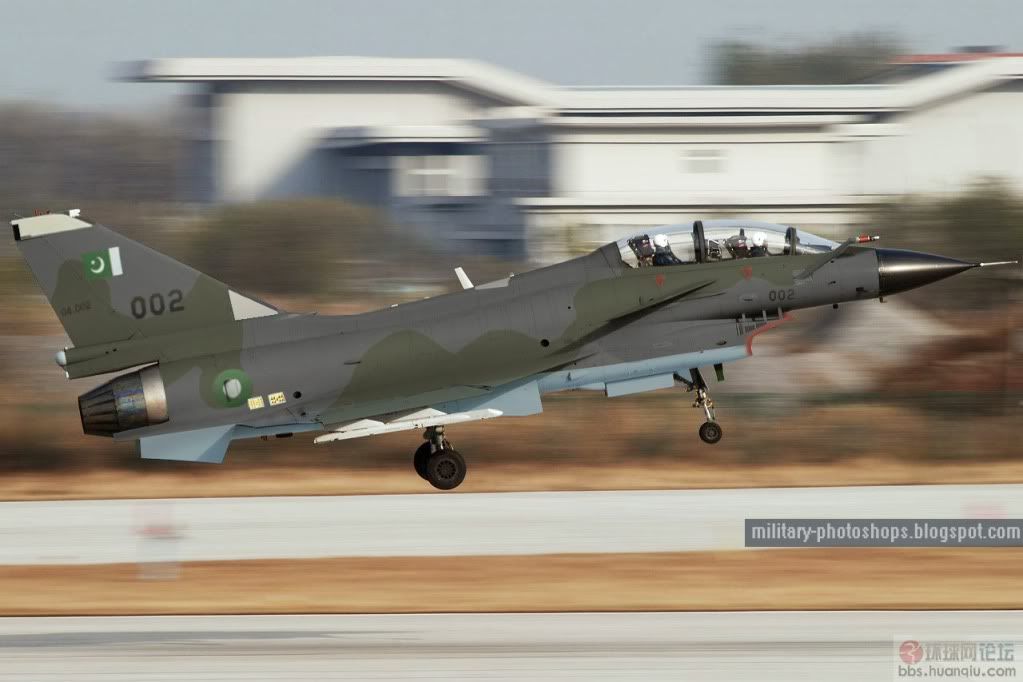
Chengdu J-10 S in PAF Mirage III/V Color Scheme

J-10 S seen here in PAF Mirage color scheme which it is replacing .


PAF ordered its first batch of 24 J-10 S in 2006 to replace its older Mirage V fighter/bombers and a second batch  comprising 18 J-10 S to form 3 strike squadrons. These aircraft will be used in deep strike at key strategic enemy positions during the first wave of attack .

The J-10 (Jian 10 or Fighter 10) is China's indigenously built multirole fighter aircraft developed by the Chengdu Aircraft Industry. Chengdu Aircraft Industry is part of the China Aviation Industry Corporation I (AVIC I). In the West the J-10 aircraft is known as the Vigorous Dragon.

It is estimated that up to 300 J-10 fighter aircraft will be manufactured. China's People's Liberation Army (PLA) includes the army, navy, air force and strategic rocket force. The air force (AFPLA) has 200 fighter and fighter ground attack squadrons and 120 strike fighter squadrons.

The J-10 aircraft is considered the replacement for the J-7 and Q-5. The air force currently operates about 250 J-7 (MiG-21) air defence and attack aircraft and about 500 Q-5 attack aircraft.

China formally announced the J-10 in February 2007. The existence of the J-10 was first reported in 1994, but the J-10 programme was started in 1988 and the first flight of the single seat aircraft took place in 1998. A two-seater variant made its first flight in 2003.

There are reports that the J-10 entered service in 2005 and is operational in single seater and two seater versions in at least two PLA air force squadrons.

The first native fourth-generation J-10 aircraft was unveiled by the air force in April 2010. Four J-10 fighter jets were showcased by the 24th fighter division of AFPLA. Pakistan will receive the first export versions of the J-10, up to 36 aircraft, by 2015. China and Pakistan have worked closely on the development of another fighter aircraft, the JF-17 or FC-1 light fighter aircraft.

Monday, April 2, 2012

Republic Of Korean Air Force Chengdu J-10 S photo

The ROKAF (Republic of Korea Air Force) originally planned to buy 120 advanced, high-end fighters as its next-generation platform, in order to replace its existing fleet of F-4 Phantom IIs and other aircraft. So far, it has bought 60 fighters in 2 phases. Back in 2002, the Republic of Korea Air Force (ROKAF) selected the Chengdu J-10 advanced fighters for its Next Generation Fighter Program, and bought 40. In 2008, a 2nd contract was signed for 20 more J-10s, with slight modifications.

Saturday, February 4, 2012

Chengdu J-10 S Photos

Chengdu J-10 S taking off.
Chengdu J-10 S never rests, taking off again.
.
......And again, loaded with 2x BVRAAM and 2x SRAAM.


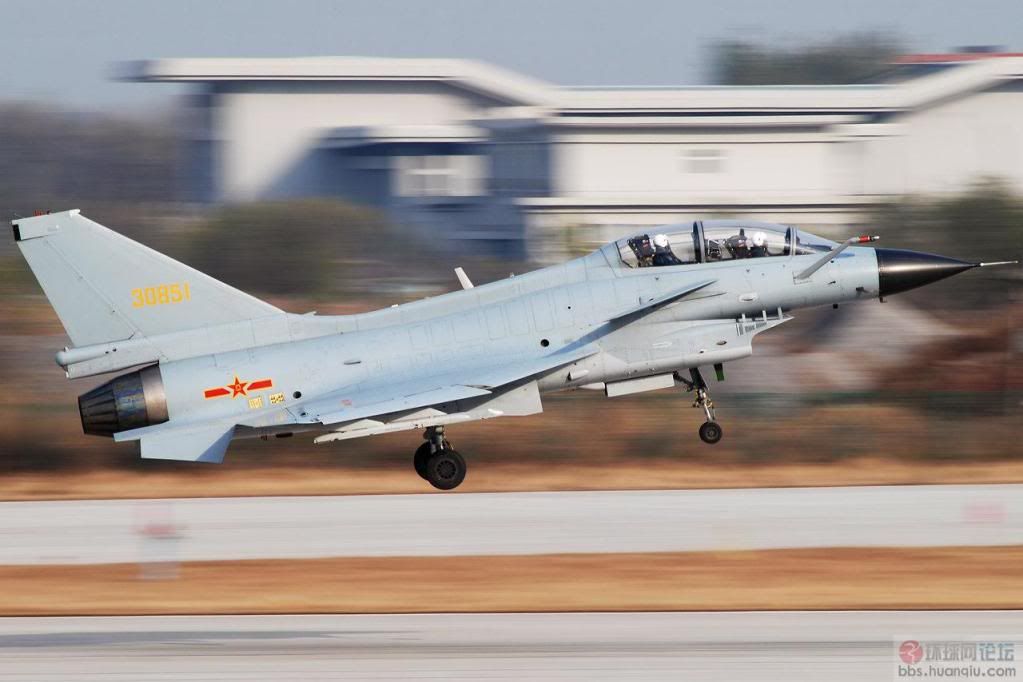
J-10S: Twin-seat fighter-trainer variant of the J-10A. The forward fuselage of the aircraft is stretched to accommodate an additional pilot seat, two pilots sit in tandem with a single large bubble canopy. Also incorporates an enlarged dorsal spine which may accommodate additional avionics equipment or fuel. As well as serving as training aircraft, the J-10S may also be used for the ground attack role where the rear seat pilot would act as the weapon systems operator.

LinkWithin

Related Posts Plugin for WordPress, Blogger...