DISCLAIMER :

Dont believe anything you read, and half of what you see, here !


If a picture doesnt have the blog address as a watermark, it means it was not edited by me. Also we intentionally photoshoped these picture in a low quality photo manipulation, because we dont want anyone to repost this as the truth.

Most of the article are not ours either. We edited it to be match our posts or simply for seo.

Use your common sense to differentiate the truth from hoax.. we sometimes mix it all in.
Showing posts with label navy. Show all posts

Friday, December 30, 2011

INS tabar repulses Somalia pirate attack


“INS Tabar encountered a pirate vessel in south west of Oman with two speedboats in tow. This vessel was similar in description to the 'mother vessel' mentioned in various piracy bulletins. INS Tabar closed in on the vessel and asked her to stop for investigation,” Indian Navy spokesperson Neerad Sinha said.
An Indian Navy ship successfully repulsed a pirate attack and fired at their 'mother vessel' in the dangerous waters of the Gulf of Aden near Somalia, an official said on Wednesday, even as the world's largest supertanker Sirius Star remained hijacked by Somali sea bandits.
INS Tabar (F44) (translated as battle axe) is the third of the Talwar-class frigates of the Indian Navy. The frigate was commissioned on 19 April 2004 in Kaliningrad, Russia. INS Tabar is the first vessel in the Talwar class to be armed with supersonic BrahMos (PJ-10) anti-ship cruise missiles. She is also equipped with Barak missiles.
The stealth frigate INS Tabar, which is currently in the pirate-infested Gulf of Aden for Anti-Piracy Surveillance and Patrol Operations, was fired at by pirates on board a ship suspected to be the 'mother vessel' late on Tuesday.


Another ship hijacked off Somalia

Following repeated calls, the vessel threatened to blow up the INS Tabar if it closed in. “Pirates were seen roaming on the upper deck of the vessel with guns and rocket propelled grenade launchers. The vessel continued threatening calls and subsequently fired upon INS Tabar.

“On being fired upon, INS Tabar retaliated in self defence and opened fire on the mother vessel. As a result, fire broke out on the pirate vessel and explosions were heard, possibly due to exploding ammunition that was stored on the vessel,” Sinha said.

Amidst all the action, two speedboats broke off to escape. “INS Tabar chased the first boat which was later found abandoned. The other boat made good its escape into darkness,” Sinha added.


The INS Tabar had last week in a daring rescue mission foiled an attempt by pirates to hijack two ships - one Indian and a Saudi Arabian merchant vessel.

An Indian Naval helicopter with marine commandoes had reached the spot immediately after receiving an SOS. The rescuers noticed at least four or five high-speed attack boats with around five-armed pirates each who were attempting to capture the Indian ship and the Saudi vessel.

INS Tabar has been patrolling the Gulf of Aden since Nov 2. During this period, she has successfully escorted approximately 35 ships, including a number of foreign flagged vessels, safely during their transit through pirate-infested waters of the Gulf of Aden.

Sirius Star, which was sailing under a Liberian flag, had been seized Saturday by Somali pirates. It is 330 metres long and can carry up to two million barrels of oil.

The latest incident comes a few days after the Japanese merchant vessel Mt Stolt Valor was released Sunday. It had been hijacked by Somalian pirates Sep 15 and had 22 crewmembers on board including 18 Indians.

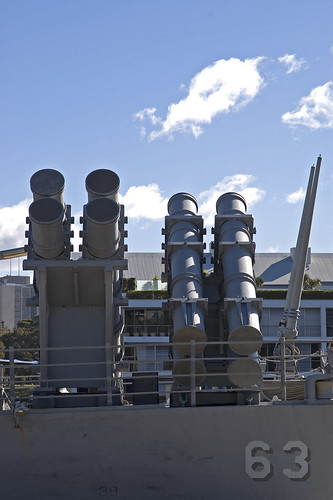
Navy Harpoon anti-ship missiles

Navy Harpoon anti-ship missiles


ATLANTIC OCEAN (April 29, 2009) A Harpoon missile is launched from the guided-missile destroyer USS Donald Cook (DDG 75) during the sinking exercise portion of UNITAS Gold. This year marks the 50th iteration of UNITAS, a multinational exercise that provides opportunities for participating nations to increase their collective ability counter illicit maritime activities that threaten regional stability. Participating countries are Brazil, Canada, Chile, Colombia, Ecuador, Germany, Mexico, Peru, U.S. and Uruguay. (U.S. Navy photo by Mass Communication Specialist Seaman Patrick Grieco/Released)

Even as some Navy commanders quietly worry about the potential threat from foreign anti-ship missiles, fewer American warships have gone to sea in the past decade with anti-ship weapons of their own. But that might change.
The Harpoon is a subsonic active homing anti-ship sea-skimming missile. It provides a long-range attack capability against hostile surface targets.

POINTS:
The Harpoon missile has a range of 70 nautical miles at a speed of 0.9 Mach.
The Harpoon is an all weather "fire and forget" missile with it's own internal guidance that takes the missile all the way to the target.
The ship carries 8 harpoon missiles.
The missile is comparable to the French-made Exocet, the Swedish RBS-15, the Russian SS-N-25 Switchblade, the British Sea Eagle and the Chinese Yingji

The Harpoon anti-ship missiles has also been adapted for use on the F-16 fighter plane, in use by the USA, Singapore, South Korea and the United Arab Emirates. It has been carried by several US Navy aircraft, including the P-3 Orion , the A-6 Intruder, the S-3 Viking, the AV-8B Harrier II jet, and the F/A-18 Hornet.
AGM-84G Harpoon Air-to-surface missile for F-16
Wingspan 3 ft (0.91 m)
Operational
range 58–196 mi (93–315 km) depending on launch platform
Flight altitude Sea-skimming
Speed 537 miles per hour (864 km/h)(240 m/s)
Guidance
system Active radar
Launch
platform multi-platform:
RGM-84A surface-launched
AGM-84A air-launched
UGM-84A submarine-launched


The Defense Advanced Research Projects Agency and the Office of Naval Research issued a $10 million contract to defense giant Lockheed Martin on June 30 to begin work on a “Long Range Anti-Ship Missile.” If the project moves forward, the Navy could begin buying an advanced, high-speed missile that would ride in cruisers’ and destroyers’ Mk 41 Vertical Launch System tubes.

In a statement, DARPA spokeswoman Jan Walker said the goal was to develop a weapon that can think and hunt without much help from its firing ship.

Today, the only anti-ship missile in the surface fleet is the RGM-84 Harpoon, carried in X-shaped racks on the sterns of cruisers and early-model destroyers. The Navy withdrew the anti-ship versions of its BGM-109 Tomahawk missiles in 1995, converting them to the land-attack variant now in cruisers’ and destroyers’ VLS tubes.

Many of today’s newer destroyers have no Harpoon launchers and, as such, no anti-ship missiles. Instead, if the ship needed to sink an enemy ship at long range, it could launch a helicopter armed with Harpoons, AGM-119 Penguins or AGM-114 Hellfire missiles. Attack jets also can carry anti-ship missiles.

U.S. commanders became wary of ship-launched anti-ship missiles in exercises in the 1980s, during which they missed or hit neutral ships about as often as they found their targets, naval weapons expert Norman Friedman said. The weapons suffered from the classic problem of needing good information about their targets.

Friedman said he was skeptical about the prospects for DARPA and ONR’s new missile. Although sensors have gotten better in the age of unmanned aerial vehicles and higher-tech satellites, the classic target-finding problem still remains, he said.

“There are constant efforts to make hypersonic missiles — you see claims about them — but they don’t seem to go anywhere.”

Who has Harpoons?
Newly built Navy surface combatants were outfitted with Harpoon anti-ship missiles until 1999, with the commissioning of the destroyer Porter, the last Flight II Arleigh Burke-class destroyer.

Starting with the first Flight IIA ship, Oscar Austin, the Navy deleted that feature from new destroyers. So that ship through the as-yet-unnamed DDG 115 do not or will not carry Harpoon missiles.

All 22 cruisers carry Harpoons.

LinkWithin

Related Posts Plugin for WordPress, Blogger...